30-degree rule
noun
The 30-degree rule is an editing and shooting guideline that the camera angle should change by at least 30 degrees between two consecutive shots of the same subject. A smaller change makes the cut look like a jump cut, because the image appears to twitch rather than offer a genuinely new view.
1 of 10 free entries left without an account. Create a free account to read without limits.
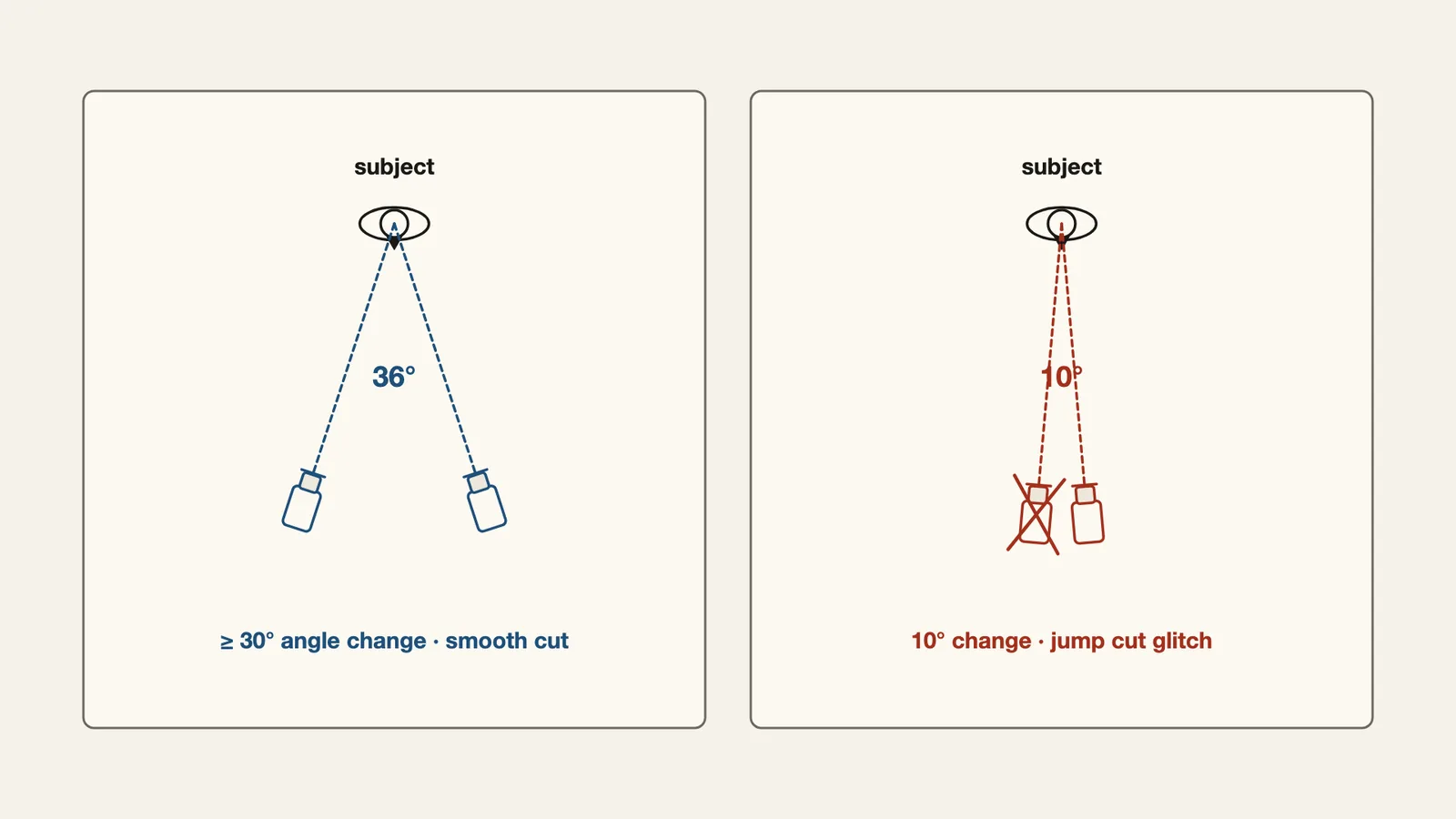
How 30-degree rule works in practice
When planning coverage, make each new set-up clearly different: move the camera at least 30 degrees around the subject, change the shot size noticeably, or ideally both. A medium shot followed by a close-up from the same spot can work if the size jump is big; a medium followed by a slightly tighter medium from the same angle usually looks like a glitch. A related rule of thumb says a lens change of under about 20 mm at the same angle feels similar. Stay on the same side of the 180-degree line while moving round. In interviews filmed with two cameras, place them at different angles and sizes so the editor can cut between them invisibly. Jump cuts can still be used deliberately, for example in vlogs to remove pauses, but then the effect should be a choice.
Word origin
Named for the minimum 30-degree shift in camera position around the subject between successive shots.
In a sentence
The second camera was only a few degrees off the first, so the cut broke the 30-degree rule and looked like a jump.
Questions people ask
Why does the 30-degree rule matter?
If two shots of the same subject are too similar in angle and size, the cut between them looks like the picture jerked or skipped, drawing attention to the edit. Changing the angle by 30 degrees or more gives the viewer a clearly new perspective, so the cut feels motivated. It keeps continuity editing invisible.
How is the 30-degree rule related to the 180-degree rule?
They work together. The 180-degree rule says stay on one side of the line of action; the 30-degree rule says move far enough between set-ups within that half-circle. Following both gives cuts that keep screen direction consistent and still feel like fresh, meaningful views of the action.
Sources we checked
Cite this entry
RAP Education Photography School. "30-degree rule." RAP Dictionary of Photography, Cinema & Visual Arts. https://dictionary.rapeducation.com/term/30-degree-rule (accessed 28 November 2026).