Actinism
noun
Actinism is the ability of light or other radiation to cause a chemical change, such as darkening a silver halide emulsion. In photography, actinic light is whatever light a given film, plate or paper responds to; non-actinic light is light it ignores, which is why safelights can be used in darkrooms.
6 of 10 free entries left without an account. Create a free account to read without limits.
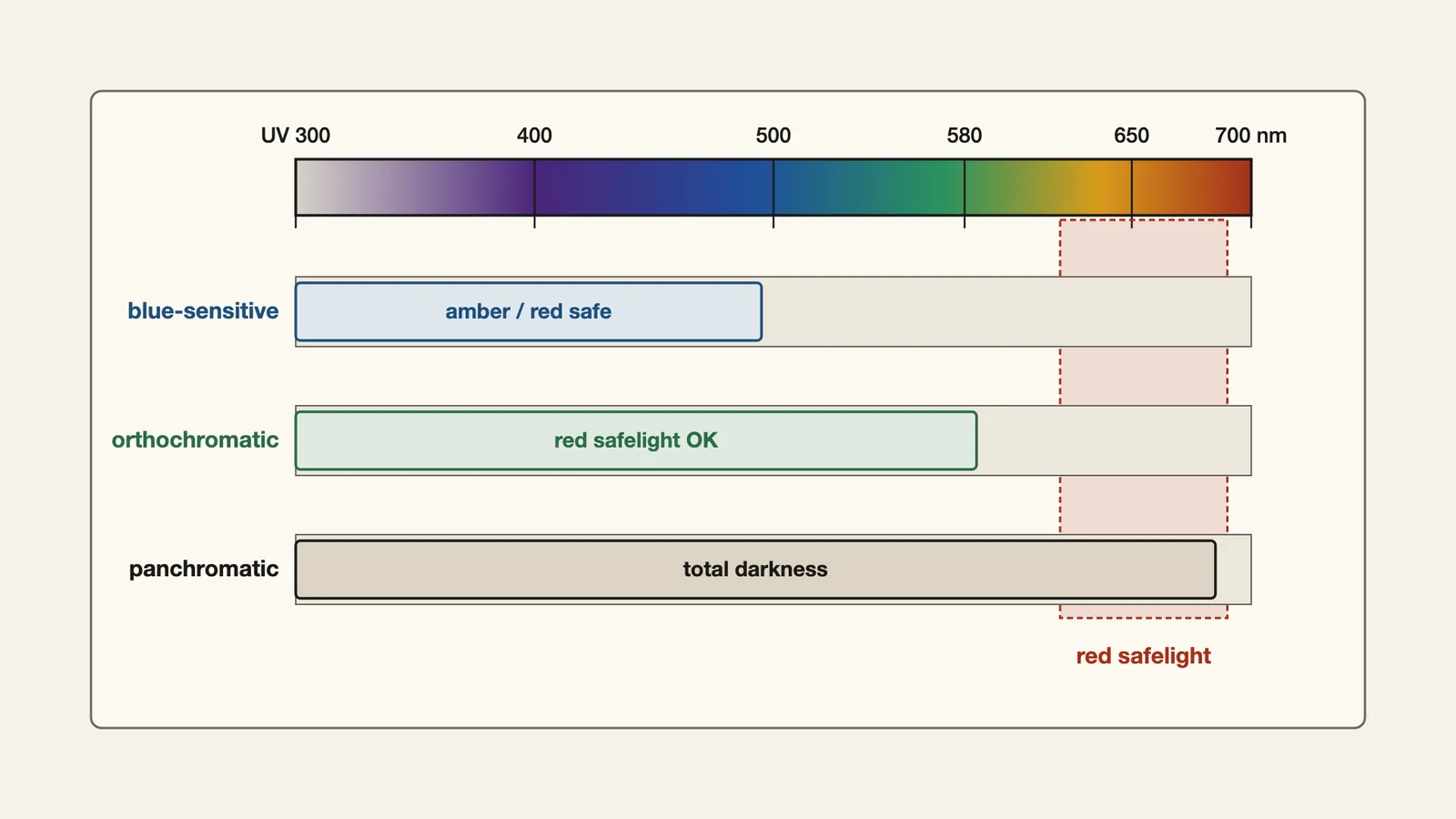
How Actinism works in practice
The word turns up constantly in 19th- and early 20th-century manuals, because early emulsions saw only blue, violet and ultraviolet. For those plates, a red dress printed almost black and a blue sky burned out to white: red was not actinic. When orthochromatic and then panchromatic films arrived, the list of actinic colours grew, so the word has to be read against a specific material. Today it matters most in two places. First, darkroom safelights: an amber or red lamp is non-actinic for black-and-white paper, but panchromatic film has no safe colour, so it must be loaded in total darkness. Second, alternative processes such as cyanotype and salt prints still respond mainly to ultraviolet, so a UV exposure unit or direct sun works far better than a household LED bulb.
Word origin
Built from actin- (from Ancient Greek aktís, aktînos, 'ray, beam') plus the suffix -ism.
History
Defined in the period's photographic dictionaries as the chemical power of light, reflecting its everyday use in plate photography.
Orthochromatic and panchromatic emulsions widened sensitivity into yellow and red, making 'actinic' depend on the material in use.
In a sentence
The old manual warned that the actinism of winter light was weak, so plates needed far longer exposures in December.
Questions people ask
What does non-actinic mean in a darkroom?
Non-actinic light is light that a particular material does not respond to. A red or amber safelight is non-actinic for most black-and-white printing papers, so you can see while you work. It is not safe for panchromatic film, which is sensitive to every visible colour and must be handled in complete darkness.
Why did red look black in early photographs?
Early plates were sensitive mainly to blue, violet and ultraviolet light. Red light carried little actinic power for them, so red objects barely exposed the plate and printed very dark. Blue skies, by contrast, overexposed quickly, which is why many 19th-century landscapes have blank white skies.
Sources we checked
Cite this entry
RAP Education Photography School. "Actinism." RAP Dictionary of Photography, Cinema & Visual Arts. https://dictionary.rapeducation.com/term/actinism (accessed 29 November 2026).