Bokeh
noun
Bokeh is the visual quality of the out-of-focus parts of a photograph: the way a particular lens renders blurred backgrounds, foregrounds and points of light. It describes the character of the blur, such as smooth or busy, round or polygonal, rather than simply how much blur there is.
9 of 10 free entries left without an account. Create a free account to read without limits.
How Bokeh works in practice
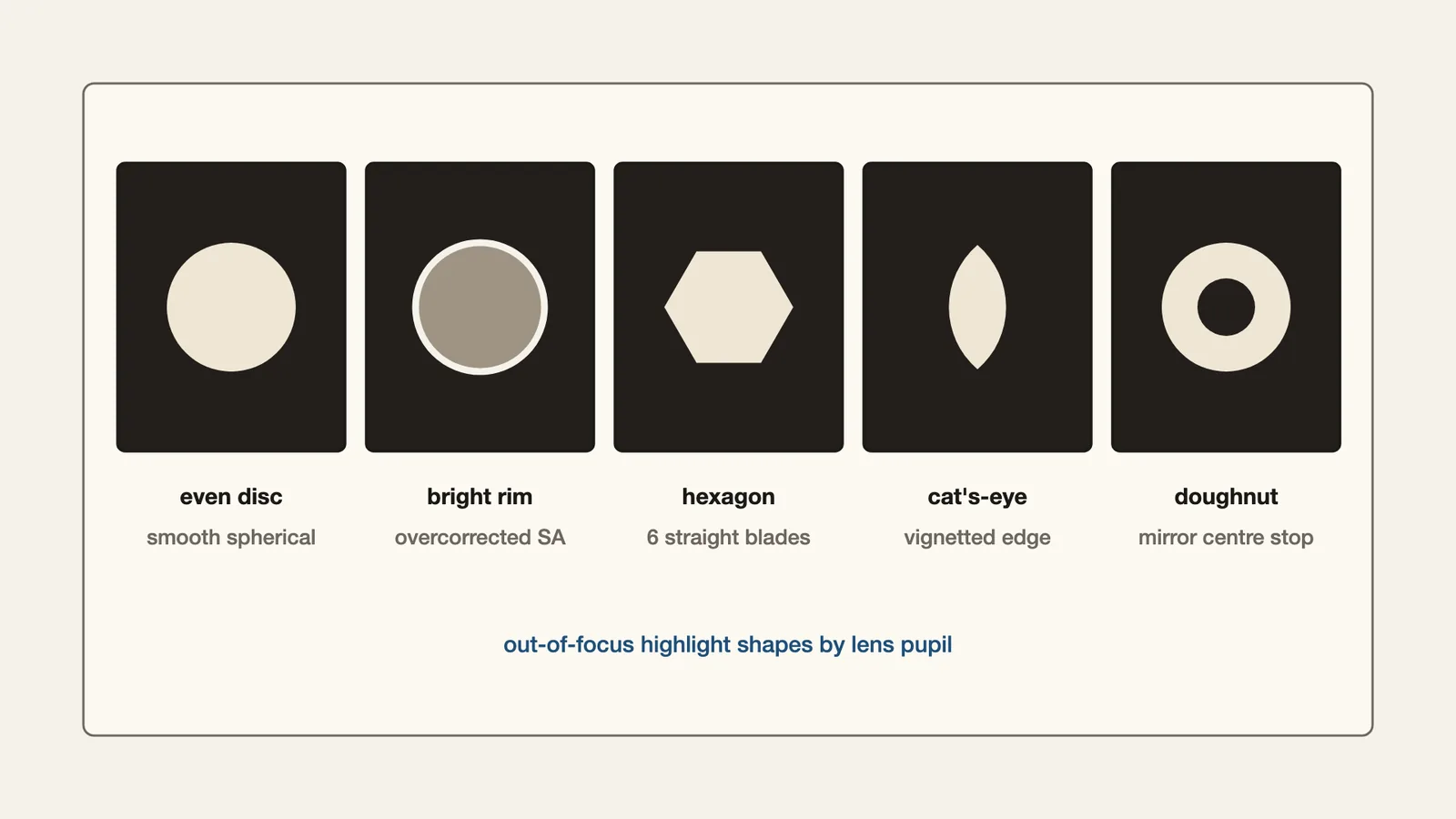
You see bokeh most with a wide aperture, a long lens, a close subject and a distant background: for example 85 mm at f/1.8 with the sitter 2 m away and street lights 20 m behind. Small bright highlights expose a lens's character. Rounded diaphragm blades keep those discs circular when you stop down slightly, while straight blades turn them into hexagons or heptagons by f/4. Near the frame edges the discs often clip into lemon or 'cat's-eye' shapes because of optical vignetting. Under- or over-corrected spherical aberration can give discs a bright rim, which makes branches and grass look nervous and doubled; imperfect aspherical moulds can add 'onion ring' texture; mirror lenses give doughnut rings. To judge a lens, photograph backlit leaves and fairy lights rather than a plain wall, and compare wide open with one stop down.
Word origin
From Japanese boke (暈け/ボケ), 'blur, haze', the noun form of the verb bokeru, 'to become blurred'. In 1997 Mike Johnston, editor of Photo Techniques magazine, spelled it bokeh in three articles so that English readers would not rhyme it with 'stoke'.
History
Mike Johnston uses the spelling 'bokeh' in three Photo Techniques articles to guide English pronunciation.
The spelling 'bokeh' appears in photography books, according to the record traced in Wikipedia's article.
In a sentence
The old Helios lens gives a swirling bokeh that suits backlit portraits in a garden.
Questions people ask
Is bokeh the same as depth of field?
No. Depth of field is how much of the scene looks sharp; bokeh is what the unsharp part looks like. Two lenses set to the same focal length, aperture and distance give almost the same depth of field, yet one may render the background as creamy and smooth while the other makes it harsh, outlined or swirly. Shallow depth of field gives bokeh a chance to show; it does not decide its quality.
How do I get good bokeh on a budget?
Use the widest aperture your lens allows, move close to your subject and put plenty of distance between the subject and the background. A cheap 50 mm f/1.8 prime on full frame or APS-C will blur backgrounds far more than a kit zoom at f/5.6. Choose backgrounds with small, scattered lights or dappled leaves, and avoid busy high-contrast lines that look harsh when defocused.
Sources we checked
Cite this entry
RAP Education Photography School. "Bokeh." RAP Dictionary of Photography, Cinema & Visual Arts. https://dictionary.rapeducation.com/term/bokeh (accessed 29 November 2026).