Camera lucida
noun
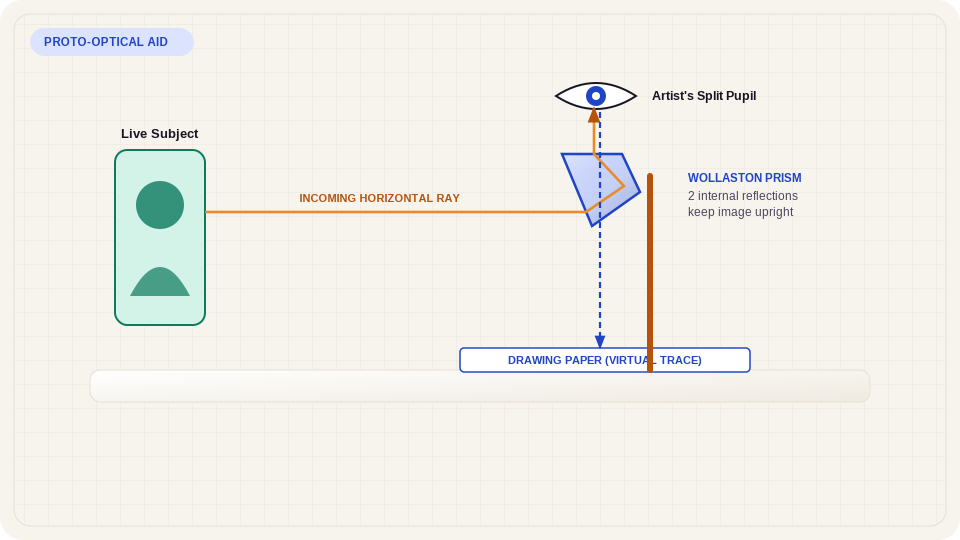
A camera lucida is a portable drawing aid in which a prism or half-silvered mirror lets the artist see the subject and the paper at the same time, so the scene appears to lie on the page and can be traced. Unlike a camera obscura, it projects nothing and needs no darkness.
7 of 10 free entries left without an account. Create a free account to read without limits.
Meanings
- Photography theoryCamera Lucida (French La Chambre claire, 1980; English 1981) is Roland Barthes's book-length essay on photography, which introduced the terms studium and punctum.
How Camera lucida works in practice
Using one takes practice. You clamp the instrument above a drawing board, look down through the prism with one eye and position your head so that the subject and your pencil tip are both visible. Move your eye a few millimetres and the overlay slides out of register, so keep still and work in short sessions. Matching brightness matters: if the subject is much brighter than the paper, you will not see your pencil, so light the page or shade the subject. Microscopists used camera lucida attachments to draw specimens into the 1980s, and some illustrators still use them. For photographers the device matters for one story: Henry Fox Talbot's frustration with his camera lucida sketches at Lake Como in October 1833 pushed him to look for a way to make images fix themselves.
Word origin
New Latin, 'light chamber', coined as a deliberate contrast with camera obscura, 'dark chamber'. Barthes's French title La Chambre claire translates the same phrase.
History
Johannes Kepler describes optics similar to the later device; no working instrument by him is known.
William Hyde Wollaston patents the camera lucida in England (some sources date the invention or description to 1807).
Talbot's disappointing camera lucida drawings at Lake Como start his search for a photographic process.
Roland Barthes publishes La Chambre claire, translated as Camera Lucida in 1981.
David Hockney's Secret Knowledge argues that some Old Masters used optical aids, suggesting Ingres may have used a camera lucida.
In a sentence
She sketched the cathedral facade with a camera lucida, tracing the outline the prism laid over her paper.
Questions people ask
What is the difference between a camera lucida and a camera obscura?
A camera obscura is a dark box or room that projects an image of the scene onto a surface. A camera lucida projects nothing: it is a small prism on a stand that optically superimposes the scene over your drawing paper as seen by your eye. It works in ordinary daylight and is light enough to carry.
Why is Barthes's book called Camera Lucida?
The French title, La Chambre claire, means 'the bright room', the literal translation of camera lucida. Barthes used it in contrast to the dark chamber usually associated with photography, reflecting his view that a photograph's force lies in its plain, open presence of what once stood before the lens rather than in hidden technique.
Sources we checked
Cite this entry
RAP Education Photography School. "Camera lucida." RAP Dictionary of Photography, Cinema & Visual Arts. https://dictionary.rapeducation.com/term/camera-lucida (accessed 29 November 2026).