Codec
noun
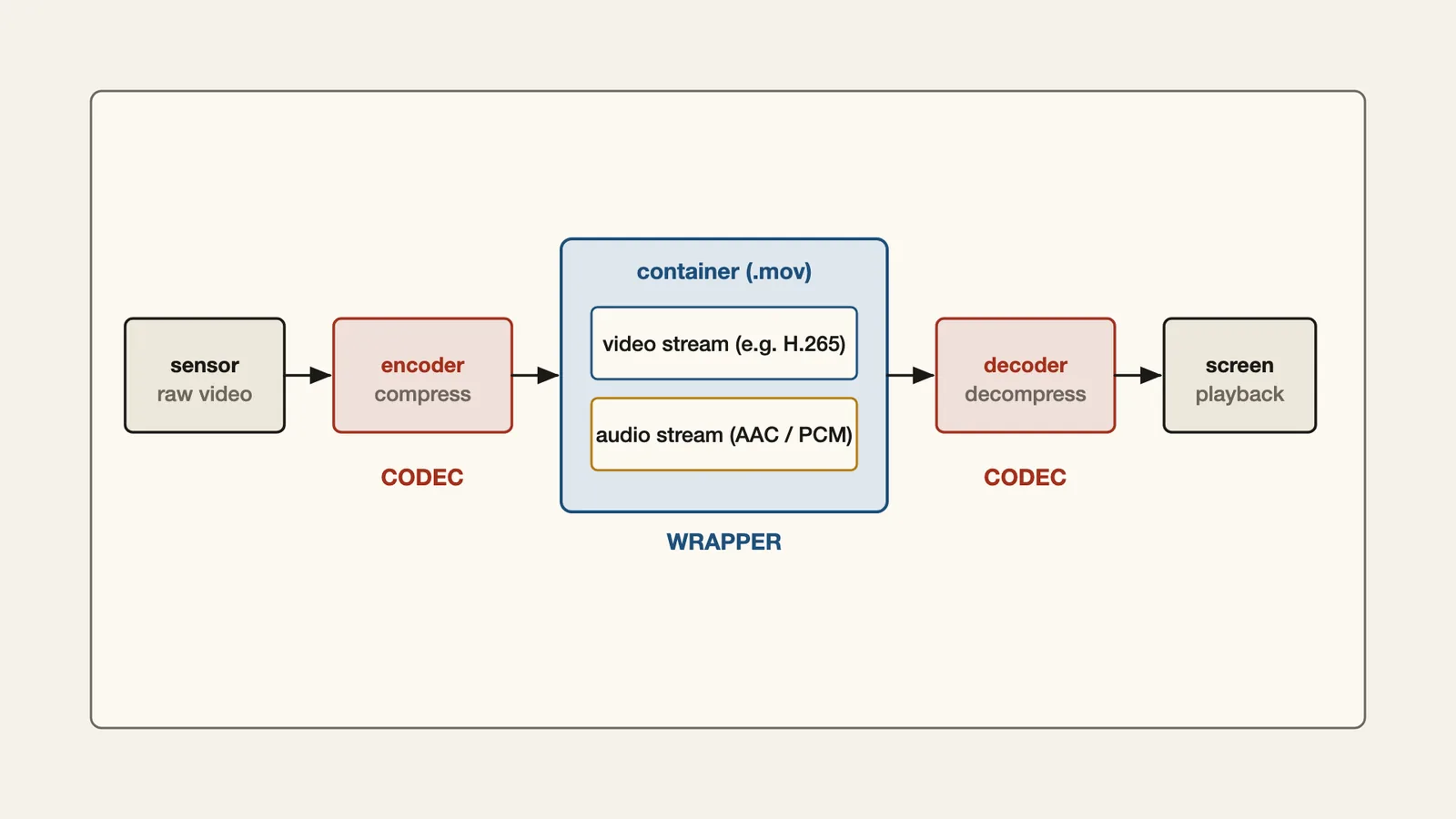
A codec is software or hardware that encodes video or audio into a compact digital form for storage or transmission, and decodes it again for playback or editing. H.264, HEVC, AV1, Apple ProRes and AAC are all codecs; the codec largely decides file size, image quality and how hard a computer must work to play the file.
9 of 10 free entries left without an account. Create a free account to read without limits.
How Codec works in practice
Keep codec and container apart: .mp4, .mov and .mxf are containers that hold encoded streams plus metadata, so two .mov files can use completely different codecs. Camera codecs fall into two broad families. Long-GOP codecs such as H.264 and H.265 store full frames only occasionally and predict the rest, giving small files that are heavy to decode; intra-frame codecs such as ProRes or All-I modes compress each frame separately, making bigger files that scrub smoothly. If 10-bit HEVC footage stutters on your laptop, make proxies or transcode to an editing codec. For delivery, H.264 in an MP4 is still the most widely accepted choice. Every lossy re-encode throws away more detail, so export one high-quality master and make platform versions from it. A tool such as MediaInfo shows which codec a file actually uses.
Word origin
A blend of coder and decoder, probably formed on the model of modem (modulator-demodulator). It first named hardware that converted analogue signals to digital pulse-code modulation and back.
In a sentence
The footage looked fine on the camera but would not play on the client's PC because it was recorded in a codec their laptop could not decode.
Questions people ask
What is the difference between a codec and a container?
The codec is the method used to compress and decompress the actual audio or video data. The container is the file wrapper that holds one or more of those streams together with timing and metadata. An .mp4 file is a container that might hold H.264 video and AAC audio; a .mov might hold ProRes or H.265 instead.
Which codec should I use for YouTube uploads?
YouTube's own recommended upload settings specify H.264 video with High Profile, progressive scan and 4:2:0 chroma subsampling in an MP4 container, with AAC-LC or Opus audio at 48 kHz. Uploading a higher-quality master is also acceptable, because YouTube re-encodes every upload for streaming anyway.
Sources we checked
Cite this entry
RAP Education Photography School. "Codec." RAP Dictionary of Photography, Cinema & Visual Arts. https://dictionary.rapeducation.com/term/codec (accessed 28 November 2026).