Decibel (dB)
noun
A decibel is a logarithmic unit that expresses the ratio between two levels, such as two sound pressures, voltages or powers. Ten decibels equal one bel. Because it is a ratio, a decibel figure needs a reference, shown by a suffix: dB SPL for sound in air, dBFS for digital audio, dBu for line voltage.
4 of 10 free entries left without an account. Create a free account to read without limits.
Meanings
- Camera gainVideo cameras also express sensor gain in dB; on many cameras +6 dB of gain doubles signal amplitude, roughly one stop brighter.
How Decibel (dB) works in practice
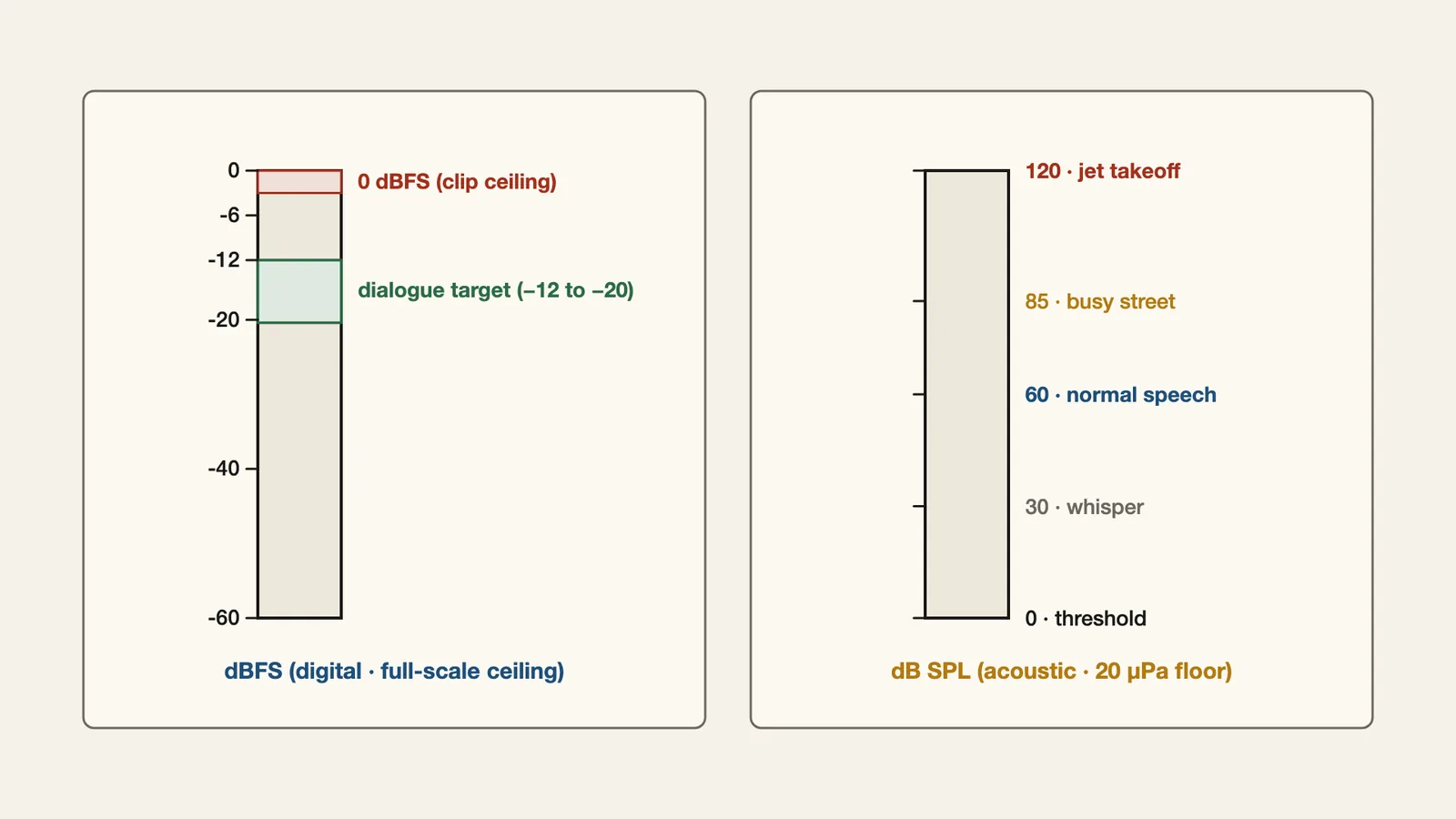
On set you meet decibels on every meter. Digital recorders show dBFS, where 0 dBFS is the clipping ceiling and everything else is negative; a common habit is to let dialogue peak around −12 to −6 dBFS to leave headroom. Remember the rules of thumb: +3 dB is about double the power, +6 dB double the amplitude, and +10 dB ten times the power, which most listeners hear as roughly twice as loud. Sound pressure in a room is measured in dB SPL, referenced to 20 micropascals, near the quietest sound people can hear. Loud environments around 120 dB SPL can damage hearing quickly, so wear protection at concerts and near generators. Delivery specs add loudness units (LUFS), which are related to decibels but weighted for perception.
Word origin
From deci-, one tenth, plus bel, a unit named after Alexander Graham Bell. The Bell System adopted the name decibel in 1928 for its transmission unit.
History
Bell Telephone Laboratories replaced 'miles of standard cable' with the Transmission Unit for measuring line loss.
The Transmission Unit was renamed the decibel, one tenth of a bel named after Alexander Graham Bell.
In a sentence
The mixer set the boom channel so the actor's loudest line peaked at −8 dB on the recorder.
Questions people ask
What is the difference between dB and dBFS?
dB on its own is just a ratio between two levels. dBFS means decibels relative to full scale, the maximum level a digital system can record before clipping. That is why digital meters top out at 0 dBFS and normal signals read as negative numbers, such as −18 dBFS.
Does 6 dB mean twice as loud?
Not quite. A 6 dB increase doubles the amplitude, such as voltage or sound pressure, and a 3 dB increase doubles the power. Perceived loudness is different: most listeners hear about a 10 dB increase as roughly twice as loud. That is why small fader moves can sound bigger or smaller than expected.
Sources we checked
Cite this entry
RAP Education Photography School. "Decibel (dB)." RAP Dictionary of Photography, Cinema & Visual Arts. https://dictionary.rapeducation.com/term/decibel (accessed 29 November 2026).