Diffusion model
noun
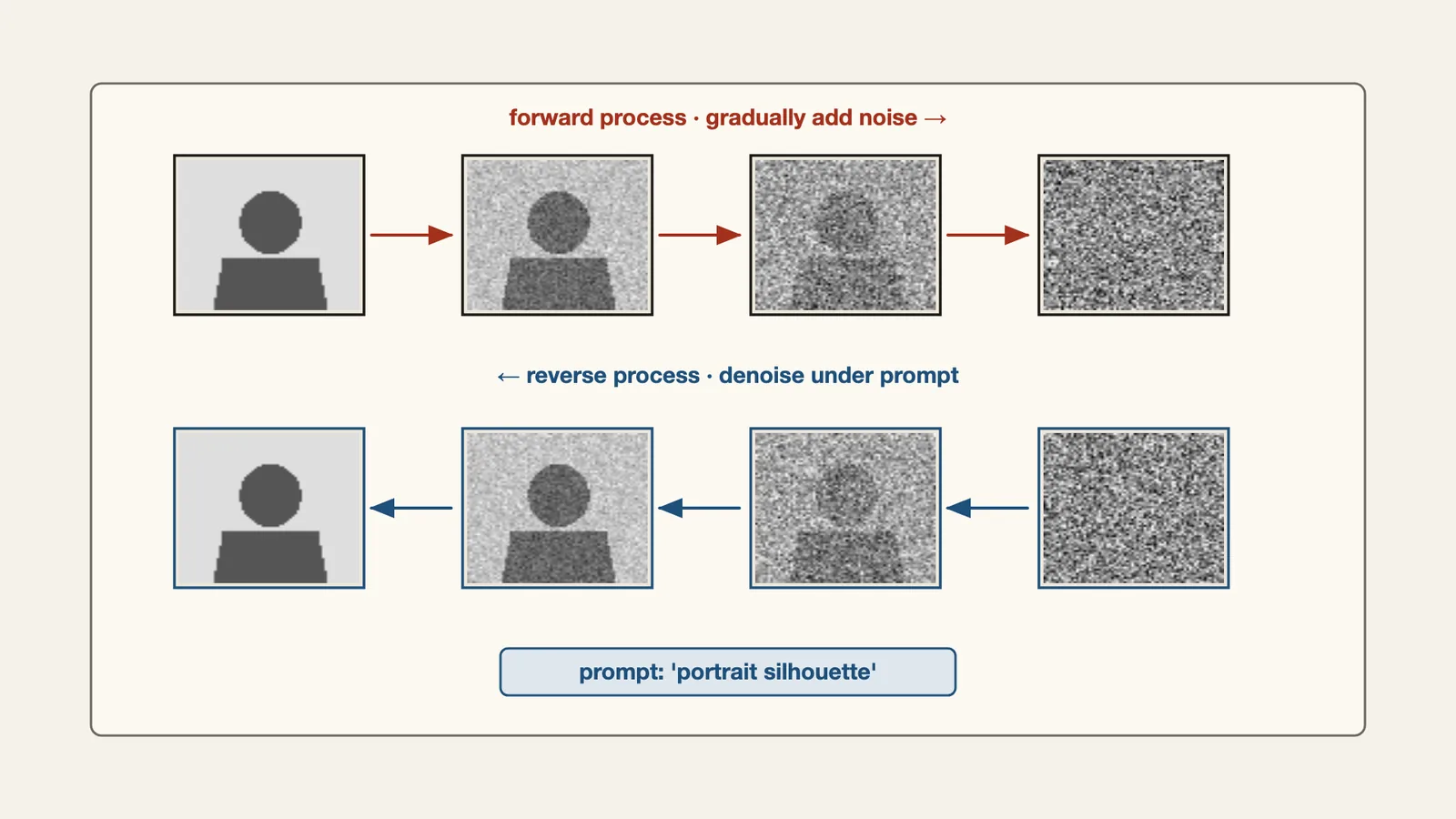
A diffusion model is a type of generative AI that creates images, video or audio by starting from random noise and removing it step by step until a picture emerges. It learns this by watching training images being gradually buried in noise and practising how to reverse each step. Stable Diffusion and DALL-E 2 use it.
4 of 5 free entries left without an account. Create a free account to read without limits.
Meanings
- PhysicsIn physics, diffusion describes particles spreading from high to low concentration; the AI method borrows the mathematics of that process, not the light-scattering sense used for lighting diffusion.
How Diffusion model works in practice
When you type a prompt into a text-to-image tool, a diffusion model is usually doing the work. Training adds Gaussian noise to images over roughly a thousand small steps; the network learns to predict and subtract that noise. At generation time it runs backwards, guided by your text. Settings you will meet include the number of sampling steps (more is slower, not always better: fast samplers can give similar results in about 20), the guidance or CFG scale (higher follows the prompt more literally but can look harsh) and the seed (the same seed and settings reproduce the same image). Inpainting and generative fill in photo editors apply the same idea to a masked area. For professional work, check the tool's licence terms and disclose synthetic imagery to clients.
Origin & history
Named after diffusion processes in thermodynamics, from Latin diffusio, a pouring out or spreading, because the training procedure mimics noise steadily spreading through the data.
Researchers introduced diffusion models as a way to sample complex data, drawing on non-equilibrium thermodynamics.
Ho and colleagues published Denoising Diffusion Probabilistic Models (DDPM), sharply improving image quality.
OpenAI's DALL-E 2 (April) and Stability AI's openly released Stable Diffusion (August) brought diffusion image generation to the public; Google announced Imagen in May.
In a sentence
The retoucher explained that the app's generative fill runs a diffusion model only inside the masked area.
Questions people ask
How is a diffusion model different from a GAN?
A GAN trains two networks against each other, a generator and a discriminator, and makes an image in one pass. A diffusion model trains a single network to remove noise and builds the image over many small steps. Diffusion models are generally more stable to train and cover a wider variety of images, though they are slower to sample.
What does CFG scale mean in image generators?
CFG stands for classifier-free guidance. The model predicts the noise twice, once with your prompt and once without, and the scale sets how far it pushes toward the prompted version. Low values give looser, more varied images; high values follow the prompt closely but can oversaturate or distort.
Sources we checked
Cite this entry
RAP Education Photography School. "Diffusion model." Lexiton, by RAP Education Photography School. https://dictionary.rapeducation.com/term/diffusion-model (accessed 29 November 2026).