Dispersion
noun
Dispersion is the variation of a material's refractive index with wavelength, which makes different colours bend by different amounts. In glass, blue light bends more than red. Dispersion is why a prism spreads white light into a spectrum, why rainbows form, and why simple lenses show coloured fringes.
8 of 10 free entries left without an account. Create a free account to read without limits.
How Dispersion works in practice
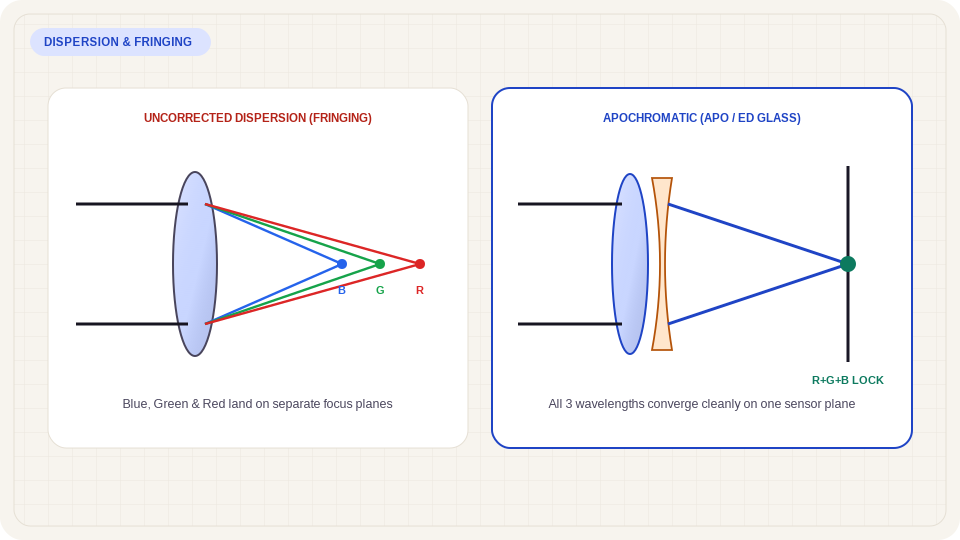
In photography dispersion appears as chromatic aberration. Because each colour focuses at a slightly different distance or image size, high-contrast edges such as branches against a bright sky pick up purple, green or magenta fringes, worst wide open and towards the frame corners. Lens makers fight it by pairing a low-dispersion crown glass with a higher-dispersion flint glass, the achromat principle, and by adding special low-dispersion elements labelled ED, UD, SLD or fluorite. A glass's dispersion is quoted as its Abbe number: higher numbers mean less colour spread. For photographers, two practical fixes exist: stop down a little to reduce axial fringing, and use the lens-profile or defringe tool in raw software for lateral fringing. Prism filters and crystal balls, by contrast, use dispersion deliberately to throw rainbow flares across a frame.
Word origin
From disperse + -ion, through Middle English dispersioun and Old French dispersion, from Latin dispersio "a scattering", from dispergere "to scatter" (dis- "apart" + spargere "to strew").
History
Isaac Newton reports to the Royal Society that a prism separates white light into colours.
John Dollond patents the achromatic doublet, pairing crown and flint glass to cancel colour dispersion.
In a sentence
The cheap kit zoom's dispersion left a magenta rim around every window frame in the cityscape.
Questions people ask
How is dispersion related to chromatic aberration?
Dispersion is the cause and chromatic aberration is the visible result. Because glass bends blue light more than red, a single lens element focuses colours at slightly different points. In photographs this shows as coloured fringes along high-contrast edges. Lens designers combine glasses with different dispersion, including ED or fluorite elements, to bring the colours back together.
What is low-dispersion (ED) glass?
ED stands for extra-low dispersion: glass whose refractive index changes relatively little across the visible spectrum, giving it a high Abbe number. Placed in a lens alongside ordinary elements, it reduces colour fringing, especially in telephoto lenses where chromatic aberration is magnified. Manufacturers use different names, such as UD or SLD, for comparable glass types.
Sources we checked
Cite this entry
RAP Education Photography School. "Dispersion." RAP Dictionary of Photography, Cinema & Visual Arts. https://dictionary.rapeducation.com/term/dispersion (accessed 29 November 2026).