Dutch angle
noun
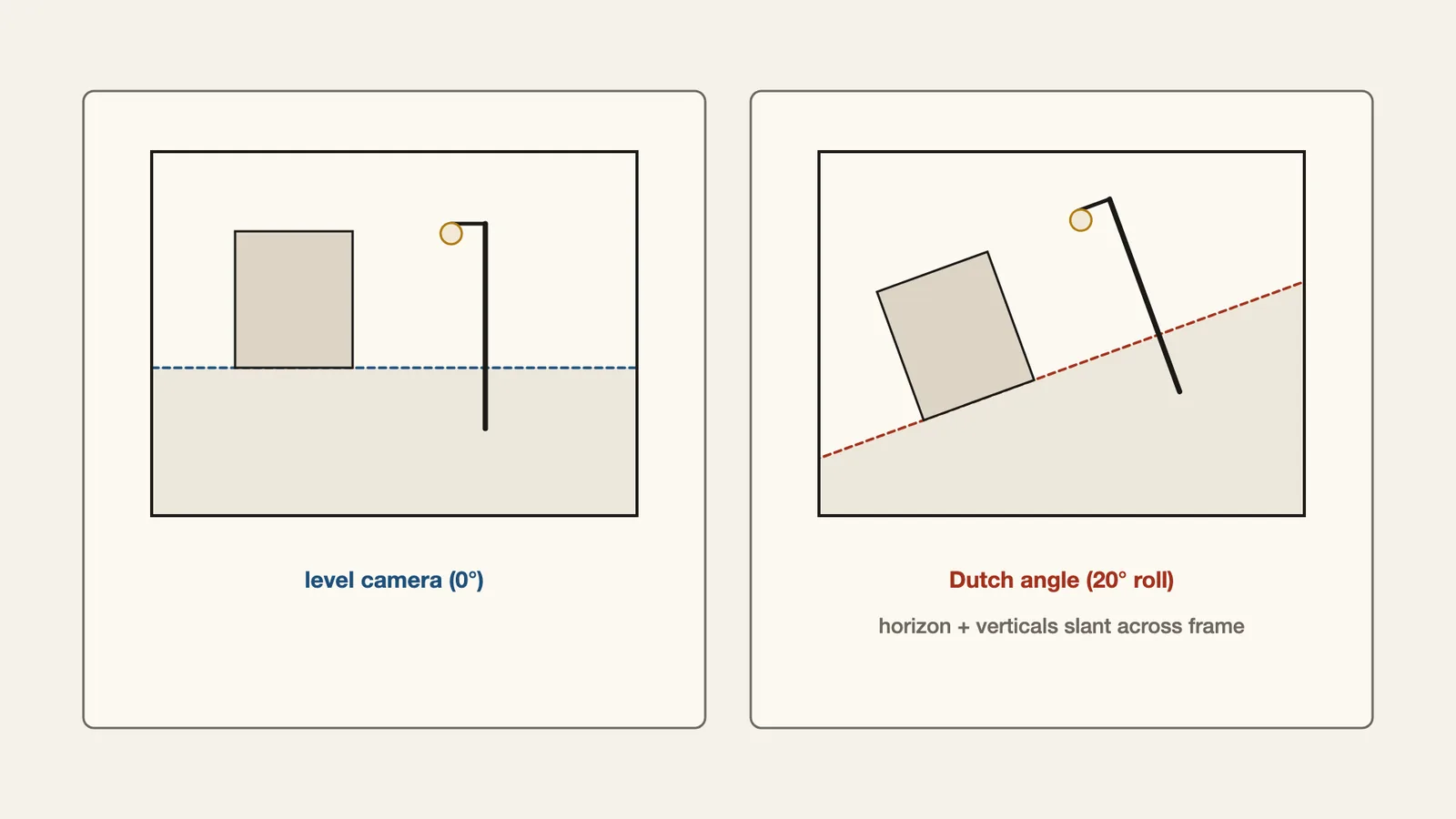
A Dutch angle is a shot in which the camera is rotated around its lens axis so the horizon and vertical lines slant across the frame. The tilted world feels unstable, so the technique signals unease, madness, disorientation or menace rather than simply showing a scene.
2 of 10 free entries left without an account. Create a free account to read without limits.
How Dutch angle works in practice
Commit to the tilt. A rotation of 5 degrees looks like a levelling mistake; 15 to 30 degrees reads as intentional. Decide which way the frame leans, since tilting toward a character's direction of travel can feel different from leaning away. Use it at moments when perception or power is off balance: a hangover, an interrogation, a villain's entrance. Wide lenses exaggerate the effect because more converging lines enter the frame. On a tripod, a Dutch head or a ball head lets you roll the camera; gimbals often have a roll setting, and phones can simply be turned. A gradual roll during a shot can show a character's world slipping. Used constantly, the device loses meaning and starts to look gimmicky, a criticism famously aimed at Battlefield Earth.
Word origin
Dutch is generally explained as a corruption of Deutsch, 'German', from the technique's association with German silent cinema; an alternative suggestion links it to an old sense of 'Dutch' meaning 'odd' or 'out of line'.
History
German Expressionist cinema used tilted frames to express madness and unrest.
Dziga Vertov's Man with a Movie Camera included canted angles among its many experimental techniques.
Carol Reed's The Third Man used Dutch angles throughout to express the alienation of post-war Vienna.
The Batman TV series and its film spin-off framed villains with crooked angles; 'Batman angle' survives as a nickname for the shot.
In a sentence
The interrogation switches to a Dutch angle the moment the suspect begins to lie.
Questions people ask
Why is it called a Dutch angle?
The most common explanation is that 'Dutch' is an English corruption of 'Deutsch', meaning German, because the tilted frame was strongly associated with German silent films of the 1920s. Some writers instead link it to an old use of 'Dutch' for something odd or out of line. It has nothing to do with the Netherlands.
When should you use a Dutch angle?
Use it when something is psychologically wrong: a character is drunk, frightened, lying or losing control, or a powerful villain dominates a space. It works best sparingly, so the audience notices the shift. If it appears in every scene it stops carrying meaning and can feel like a stylistic trick.
Sources we checked
Cite this entry
RAP Education Photography School. "Dutch angle." RAP Dictionary of Photography, Cinema & Visual Arts. https://dictionary.rapeducation.com/term/dutch-angle (accessed 29 November 2026).