Figure-ground
noun (also used as adjective)
Figure-ground is the way vision separates a scene into a figure, the shape we attend to, and a ground, the area that seems to lie behind it. In photography it describes how clearly the subject stands out from its background through differences in tone, colour, focus or texture.
4 of 10 free entries left without an account. Create a free account to read without limits.
Meanings
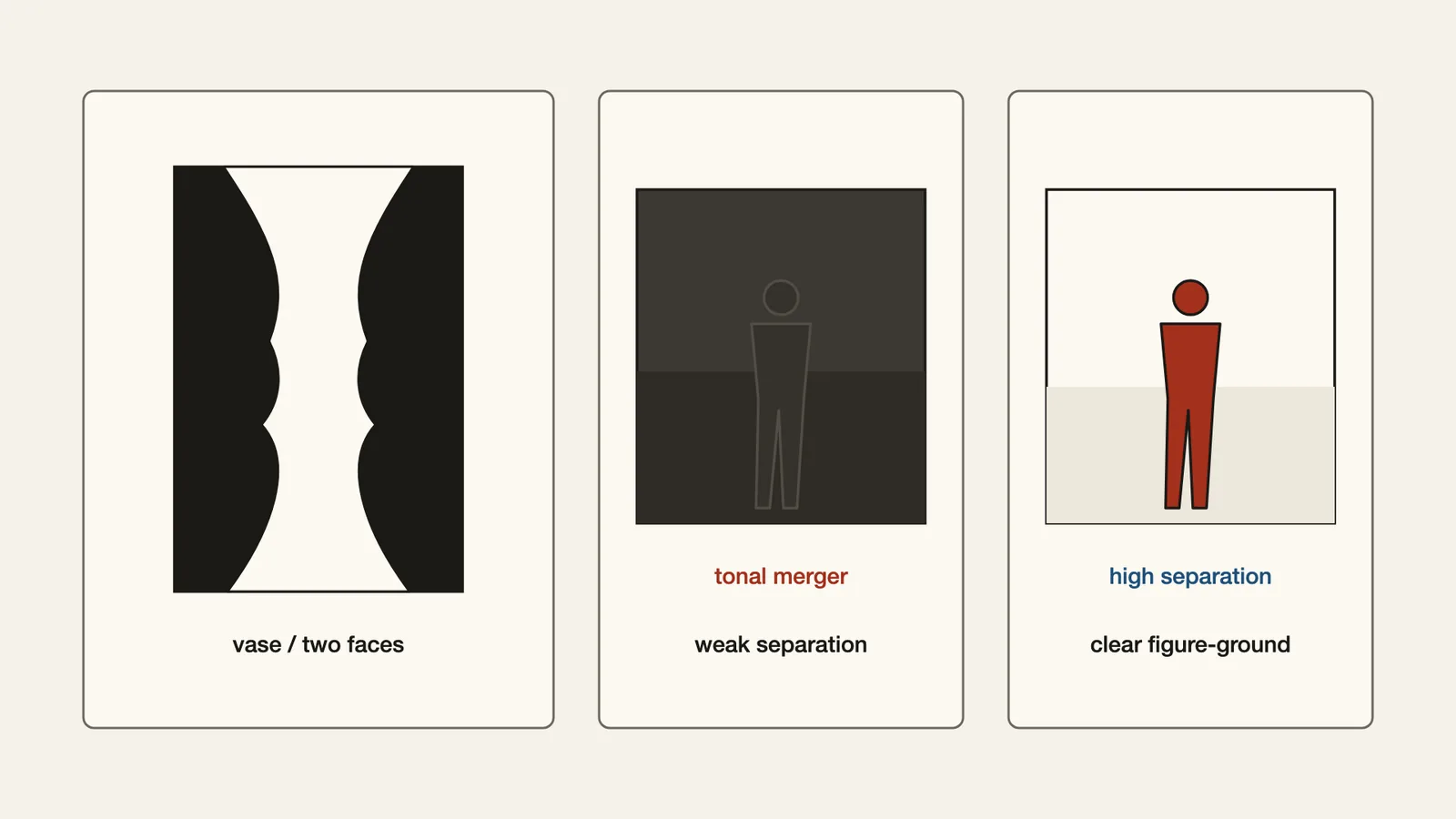
- PsychologyA form of perceptual grouping studied in Gestalt psychology, shown by reversible images such as the Rubin vase, where faces and a vase swap roles.
How Figure-ground works in practice
Strong figure-ground separation means the subject reads in a fraction of a second. Put a light subject against a dark background or the reverse, use a contrasting colour, or open the aperture so the background softens; at 85 mm and f/1.8 a face two metres away separates well from a wall five metres behind. Watch for tonal mergers, where a dark head meets a dark doorway or a white shirt meets a pale sky, because the edge disappears. Moving a step sideways often solves it. Rim light or backlight outlines a figure against a busy scene. Some photographers exploit weak figure-ground on purpose, making the viewer search, or create ambiguous images where shadow shapes and objects trade places. Check separation in a black-and-white preview, since colour can hide tonal mergers.
Word origin
An English rendering of the figure/ground distinction described by the Danish psychologist Edgar Rubin (1886–1951) in his 1915 doctoral thesis Synsoplevede Figurer ('perceived figures'). Figure here means a perceived shape, and ground means background.
History
Max Wertheimer, Wolfgang Köhler and Kurt Koffka form the Gestalt school of psychology.
Edgar Rubin publishes Synsoplevede Figurer, which introduces the vase–faces figure and analyses figure-ground perception.
In a sentence
Against the bright wall the dancer's silhouette gave a perfect figure-ground split.
Questions people ask
What is figure-ground in photography?
It is the relationship between the subject (figure) and what lies behind it (ground). Good figure-ground separation makes the subject pop out through contrast of tone, colour, sharpness or texture, so the viewer finds it instantly. Poor separation, such as a dark coat against a dark wall, makes the subject blend in. Photographers control it with background choice, lighting, aperture and camera position.
What is the Rubin vase?
It is a reversible image published by Danish psychologist Edgar Rubin in 1915. A central white shape reads as a vase, but the black areas on either side read as two facing profiles. The eye can hold only one reading at a time, which shows that the brain actively decides which region is figure and which is ground.
Sources we checked
Cite this entry
RAP Education Photography School. "Figure-ground." RAP Dictionary of Photography, Cinema & Visual Arts. https://dictionary.rapeducation.com/term/figure-ground (accessed 29 November 2026).