High dynamic range (HDR)
noun; also used as a modifier (an HDR image)
High dynamic range (HDR) describes images, techniques and displays that handle a wider span from dark to bright than standard ones. In photography it usually means merging several differently exposed frames of one scene into a single image that keeps detail in both deep shadows and bright highlights.
2 of 10 free entries left without an account. Create a free account to read without limits.
Meanings
- Video and displaysContent and screens that show brighter highlights and deeper blacks than standard dynamic range (SDR) video, using formats such as HDR10, HDR10+, Dolby Vision and HLG. Here HDR describes how the picture is delivered and shown, not a merge of exposures.
How High dynamic range (HDR) works in practice
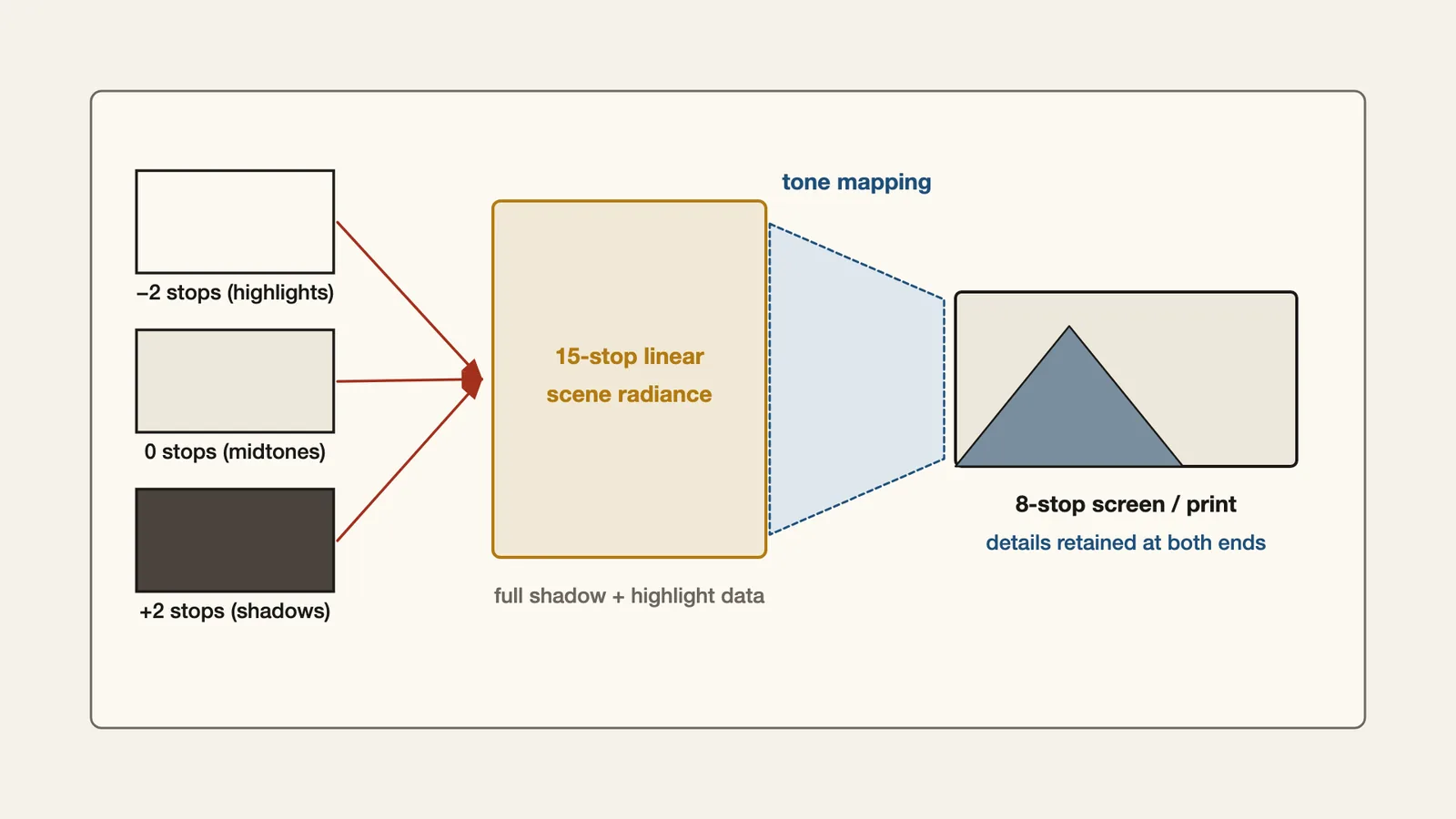
The classic workflow is to put the camera on a tripod, bracket three to seven frames a stop or two apart, merge them in software into a 32-bit file, then tone-map that file back into a range a screen or print can show. Tone mapping is where results succeed or fail. Pushed hard, it produces grey skies, glowing halos along edges and flat, cartoonish colour, the look that gave HDR a poor reputation. Handled gently, the result simply resembles what your eye saw in a church interior or a forest at sunrise. Phones now bracket and merge automatically in a fraction of a second, and many cameras offer an in-camera HDR mode. With moving subjects, a single raw frame exposed to protect the highlights and lifted carefully in editing can beat a merge spoiled by ghosting.
Word origin
A descriptive phrase: high plus dynamic range, the span between the darkest and brightest levels a system can record or show. It is used in contrast with standard dynamic range (SDR) and, in imaging research, low dynamic range (LDR).
History
Gustave Le Gray printed seascapes such as The Great Wave, Sète from two negatives, one exposed for the sea and one for the sky.
Steve Mann presented 'Compositing Multiple Pictures of the Same Scene' at the IS&T annual conference, an early report of digitally combining exposures to extend range.
Paul Debevec and Jitendra Malik's SIGGRAPH paper showed how to recover a radiance map from photographs taken at different exposures.
BrightSide Technologies demonstrated the first HDR display, an LCD with individually controlled LED backlights, at SID Display Week.
The UHD Alliance announced certification requirements for HDR televisions on 4 January.
In a sentence
The HDR merge recovered the stained-glass colours without turning the church pews to black.
Questions people ask
Is HDR photography the same as HDR on my TV?
No, though they share a name. HDR photography combines several exposures so one image holds a wide range of tones, then usually compresses that range to suit an ordinary screen or print. HDR video and HDR televisions keep the wide range all the way to the viewer, using brighter, higher-contrast displays and formats such as HDR10 or Dolby Vision.
Why do some HDR photos look fake?
Usually because of heavy tone mapping. To squeeze a wide range into a normal image, software boosts local contrast, which can leave halos around buildings, skies darker than the land and oversaturated colour. Real scenes rarely look like that, so viewers sense something wrong. Lighter adjustments, keeping skies brighter than the foreground and checking edges at full size avoid most of the problem.
Sources we checked
Cite this entry
RAP Education Photography School. "High dynamic range (HDR)." RAP Dictionary of Photography, Cinema & Visual Arts. https://dictionary.rapeducation.com/term/high-dynamic-range (accessed 29 November 2026).