Illuminance
noun
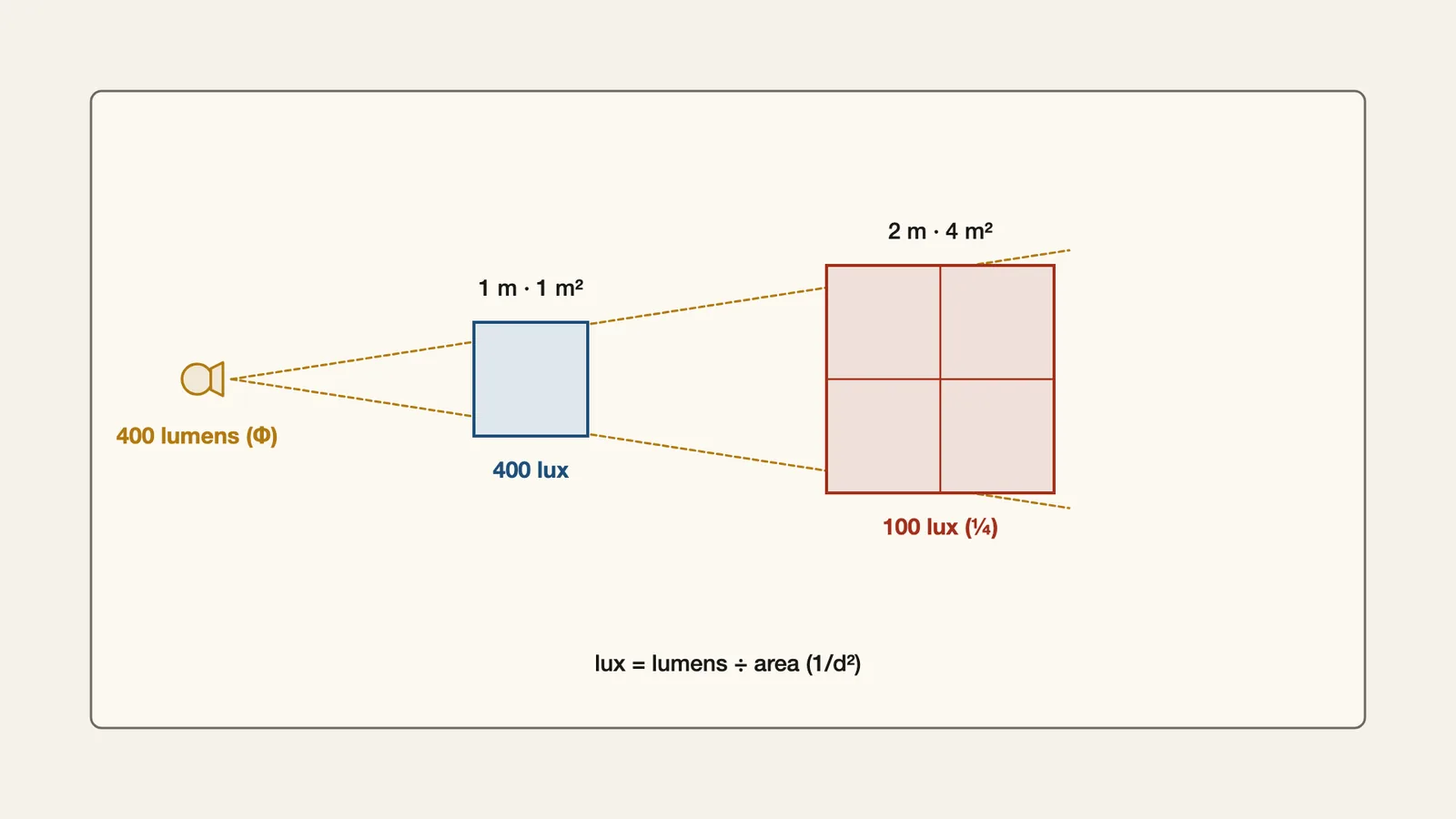
Illuminance is the amount of visible light falling on a surface per unit area, weighted for human vision. Its SI unit is the lux, one lumen per square metre; American practice also uses the foot-candle, equal to about 10.76 lux. Illuminance describes the light arriving at a subject, regardless of what the subject is made of.
6 of 10 free entries left without an account. Create a free account to read without limits.
How Illuminance works in practice
An incident light meter with its white dome measures illuminance, which is why it gives the same reading for a bride's dress and a groom's black suit standing in the same light, and why incident readings are trusted for skin tones. Illuminance follows the inverse-square law: halve the distance to a small lamp and it rises fourfold. Typical figures show the range a camera must handle: about 32,000 to 100,000 lux in direct sun, roughly 1000 lux on an overcast day or in a TV studio, 320 to 500 lux in an office, and well under 1 lux under a full moon. That spread covers about 17 stops. Cinematographers in the United States often work in foot-candles; a lux meter reading of 1076 lux is 100 fc. LED panel datasheets quote illuminance at 1 m, which is more useful than lumens for planning exposure.
Word origin
From illuminate + -ance, on the model of luminance. Illuminate comes from Latin illuminatus, past participle of illuminare "to light up", from in- + luminare, from lumen "light".
In a sentence
We raised the illuminance on the set to 2000 lux so the cameras could stay at their native ISO.
Questions people ask
How do I convert lux to foot-candles?
Divide lux by about 10.764 to get foot-candles, or multiply foot-candles by 10.764 to get lux. One foot-candle is one lumen per square foot, and one lux is one lumen per square metre; the conversion factor is simply the number of square feet in a square metre. So 500 lux is about 46 fc, and 100 fc is about 1076 lux.
Why do incident meters measure illuminance?
An incident meter's diffusing dome collects light arriving at the subject from all directions in front of it, so it reports illuminance rather than how bright the subject looks. That makes it independent of subject tone: a white cat and a black cat in the same light get the same reading, and the camera then renders each at its true tone.
Sources we checked
Cite this entry
RAP Education Photography School. "Illuminance." RAP Dictionary of Photography, Cinema & Visual Arts. https://dictionary.rapeducation.com/term/illuminance (accessed 29 November 2026).