Image stabilization
noun
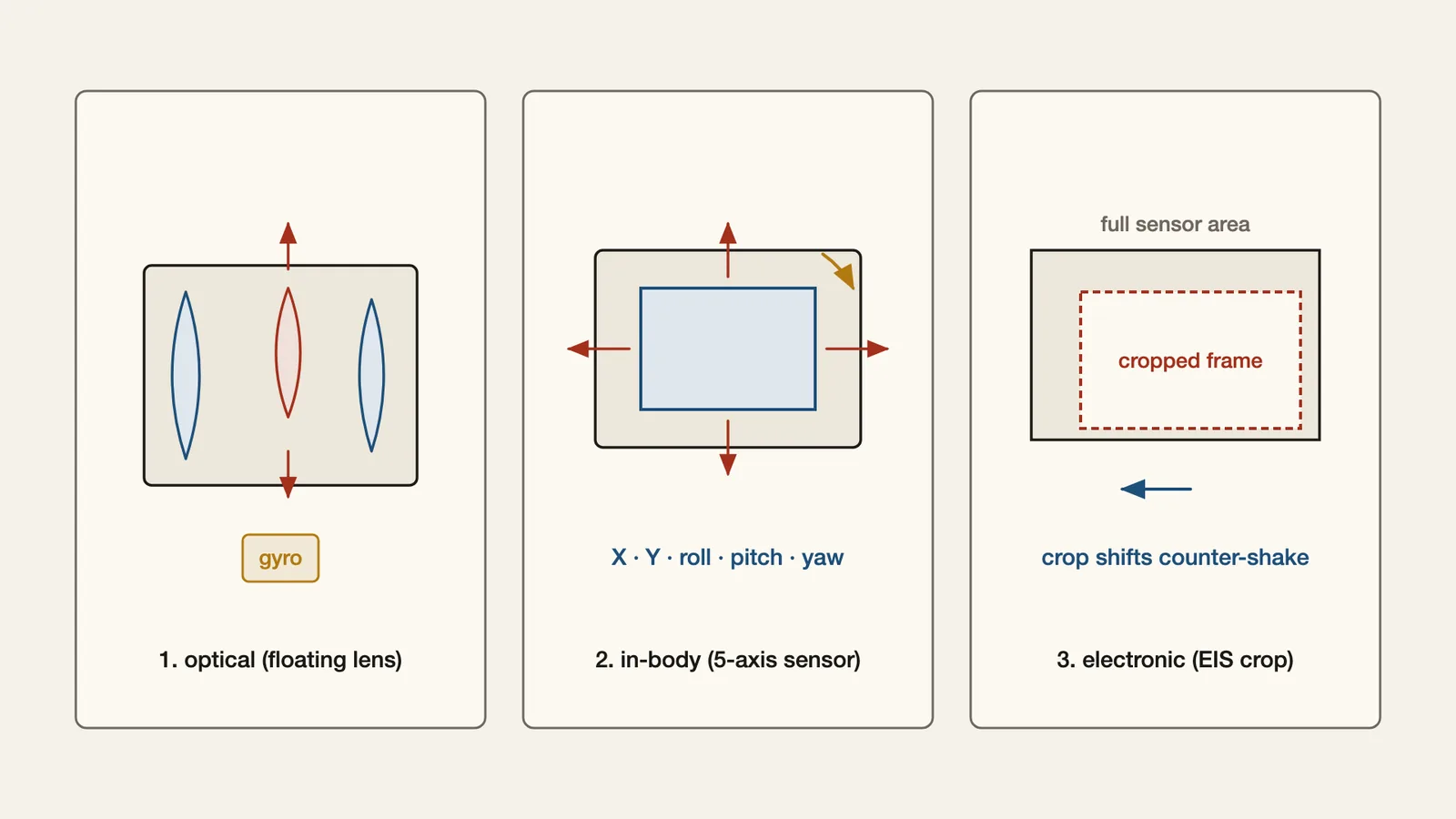
Image stabilization (IS) is any system that counters small camera movements during an exposure or recording so that hand shake does not blur the picture. It works by moving a floating lens element (optical), by moving the sensor itself (in-body, IBIS), or by shifting and cropping the frame in software (electronic).
3 of 10 free entries left without an account. Create a free account to read without limits.
How Image stabilization works in practice
The old guide says hand-hold no slower than 1/focal length, so 1/200 s at 200 mm. Makers claim gains of roughly 2 to 8 stops, so the same shot might work at 1/25 s or slower if you brace well. Stabilization only cancels your movement: a walking person still blurs at 1/15 s, so raise the shutter speed for moving subjects. Half-press for a moment before shooting so the system settles. On a tripod switch it off, unless the lens detects tripods itself, because it can add drift. Use the panning mode (often Mode 2) when following a car or bird so it corrects only up-and-down shake. In video, IBIS and electronic stabilization smooth handheld walking but crop the frame and can make the edges of wide lenses wobble; a gimbal is still better for long moves. Long telephotos rely more on lens-based systems, since sensor movement has limited range.
Word origin
A descriptive compound of image and stabilization, the act of making something steady. Each manufacturer adds its own trademark: Nikon's VR stands for Vibration Reduction, Canon uses IS, Sony uses SteadyShot and OSS, Sigma OS, Tamron VC and Pentax SR.
History
Nikon's Zoom 700VR (Zoom-Touch 105 VR in the US) offers the first optical two-axis stabilized lens.
Canon introduces the EF 75–300 mm f/4–5.6 IS USM, bringing stabilization to interchangeable SLR lenses.
Minolta's DiMAGE A1 introduces the first sensor-based two-axis stabilizer.
The Konica Minolta Maxxum 7D becomes the first DSLR with in-body image stabilization.
Panasonic's Dual IS and Olympus's Sync IS combine lens and sensor stabilization.
In a sentence
Thanks to image stabilization he hand-held the 300 mm lens at 1/60 s inside the dim fort.
Questions people ask
Should I turn off image stabilization on a tripod?
Usually, yes. Most makers recommend switching it off on a solid tripod, because a stabilizer hunting for movement that is not there can introduce slight blur or drift, especially in long exposures. Many newer lenses and bodies detect a tripod and adjust automatically; your manual will say so. On a light tripod in wind, or on a monopod, leaving it on often helps.
Is in-body stabilization better than lens stabilization?
Each has strengths. In-body stabilization works with every lens, including old manual ones, and can correct roll and shift as well as tilt. Lens-based stabilization is tuned to that optic and is generally more effective with long telephotos, and it steadies the optical viewfinder image on a DSLR. Many current systems combine both, coordinating lens and sensor for the largest gain.
Sources we checked
Cite this entry
RAP Education Photography School. "Image stabilization." RAP Dictionary of Photography, Cinema & Visual Arts. https://dictionary.rapeducation.com/term/image-stabilization (accessed 29 November 2026).