Index (semiotics)
noun (plural indexes or indices)
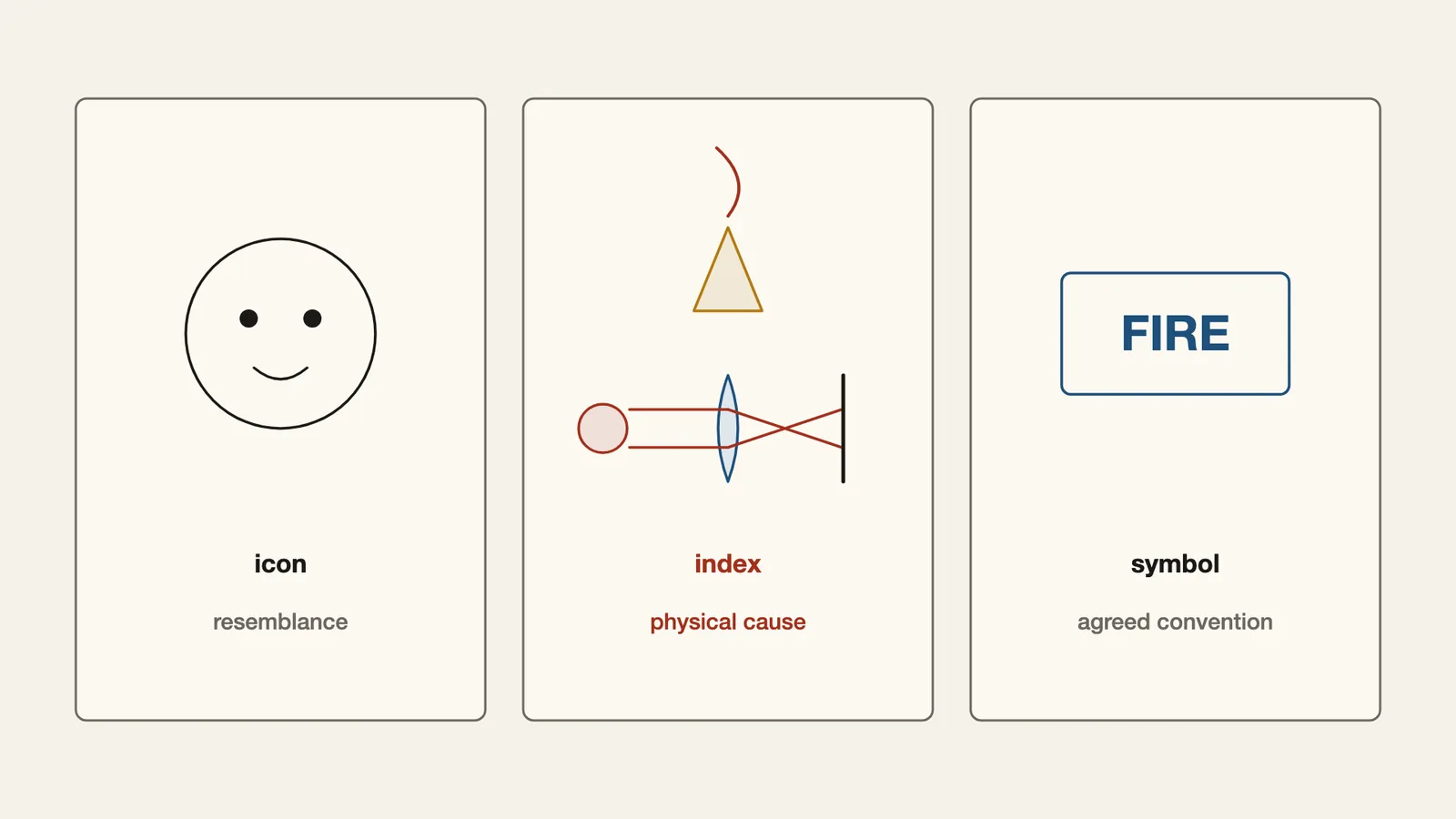
In semiotics, an index is a sign linked to what it stands for by a real physical or causal connection, rather than by resemblance or by agreed convention. Smoke indicates fire; a footprint indicates a foot. The term comes from Charles Sanders Peirce's division of signs into icon, index and symbol, first set out in 1867.
9 of 10 free entries left without an account. Create a free account to read without limits.
Meanings
- PublishingAn alphabetical list of names and topics with page numbers, usually at the back of a book.
- OpticsIn refractive index, a number describing how much a material slows and bends light; see the separate entry.
How Index (semiotics) works in practice
Photography's claim to be evidence rests on its indexical side. Light left the subject, passed through the lens and changed a film emulsion or a sensor at that moment; Peirce himself wrote, around 1894, that photographs belong with signs tied to their objects by physical connection. A photograph is also an icon, because it looks like its subject, and its caption is a symbol, a conventional code. Keeping the three apart helps when you read or defend an image. A blurred security-camera frame has weak iconic quality but strong indexical value; a painted portrait can look exactly like someone without any index at all. Editing tests the link: dodging a shadow keeps the trace, while dropping in a sky from another day breaks it for that part of the frame. Forensic tools and provenance standards try to show which parts of a file still carry the trace.
Word origin
From Latin index, “informer, pointer, forefinger, sign”, from indicare, “to point out, show”. Peirce adopted index for the pointing kind of sign; in his first 1867 paper he called this class simply “signs”.
History
Peirce presents “On a New List of Categories” (published 1868), setting out the icon, index, symbol trichotomy.
In “What Is a Sign?” (probably written early 1894) Peirce notes that photographs correspond to nature through physical connection.
Rosalind Krauss's two-part “Notes on the Index” in October applies the idea to 1970s art and photography.
In a sentence
A burn mark on paper left by a magnifying glass is a pure index of the sun's position at that moment.
Questions people ask
Is a photograph an icon or an index?
Both, according to Peirce and most later theorists. It is iconic because it resembles its subject, and indexical because light from the subject physically caused the image. A caption or a logo inside the frame adds symbolic signs on top. Debates about photographic truth usually turn on how strong the indexical link still is after framing, editing, compositing or computational processing.
What is the difference between an icon, an index and a symbol?
An icon means by resemblance, like a portrait or a map. An index means by real connection, like smoke for fire, a weathervane for wind or a photograph for its subject. A symbol means by convention that has to be learned, like a word, a traffic colour or a national flag. Peirce stressed that real signs often mix all three modes.
Sources we checked
Cite this entry
RAP Education Photography School. "Index (semiotics)." RAP Dictionary of Photography, Cinema & Visual Arts. https://dictionary.rapeducation.com/term/index-semiotics (accessed 28 November 2026).