Kernel (image processing)
noun
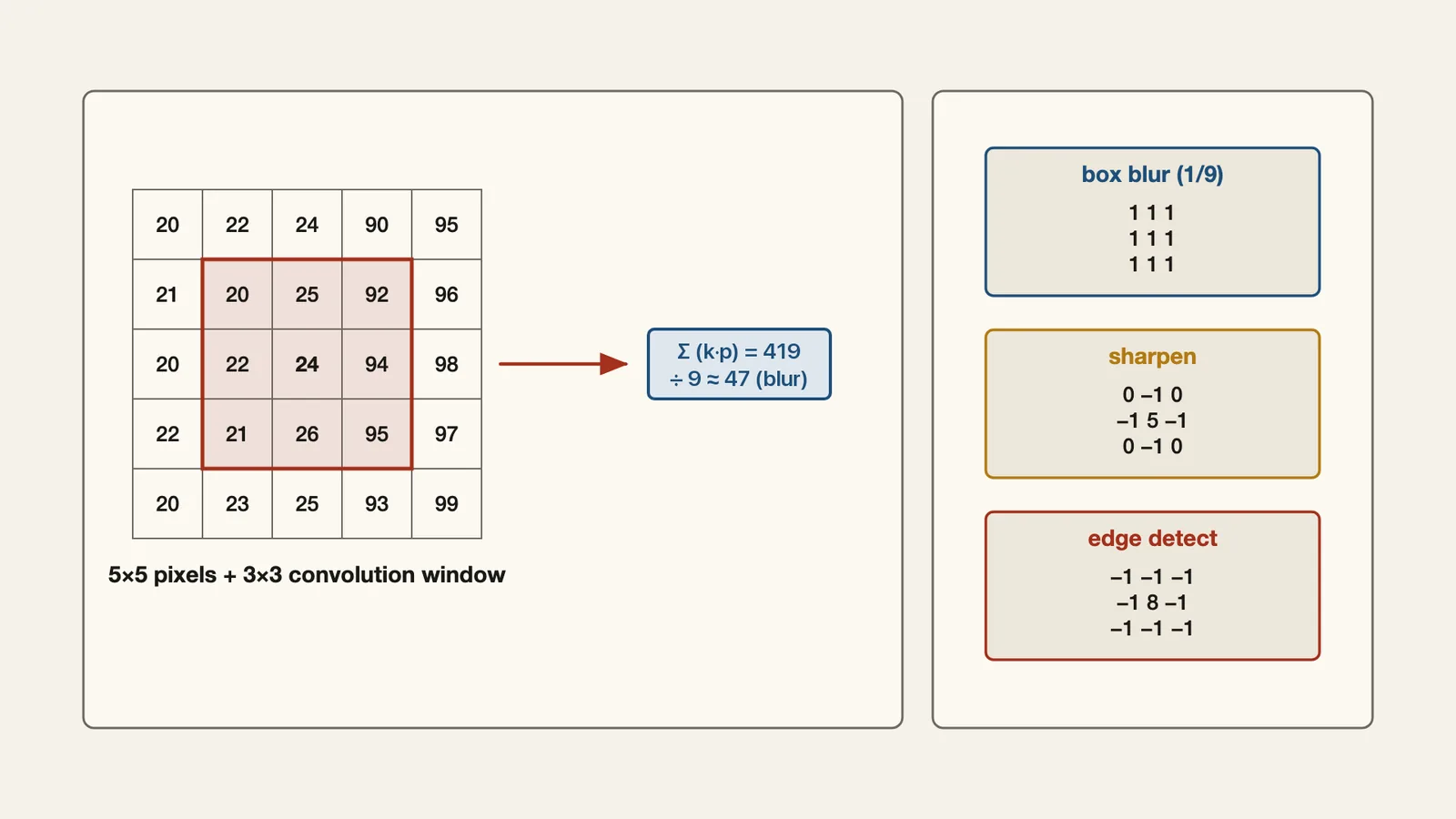
In image processing, a kernel is a small grid of numbers, often 3×3 or 5×5, that is slid across an image to compute each new pixel from its neighbours. Multiplying and summing in this way, called convolution, produces blur, sharpening, embossing or edge detection, depending on the numbers in the kernel.
3 of 10 free entries left without an account. Create a free account to read without limits.
Meanings
- ComputingThe core of an operating system, an unrelated meaning.
How Kernel (image processing) works in practice
Every sharpening or blur slider you move applies a kernel. A 3×3 box blur gives each of nine pixels a weight of 1/9 and averages them; a Gaussian blur uses weights that fall off from the centre, so it looks smoother. A common sharpen kernel puts 5 in the centre and −1 above, below, left and right: it boosts the difference between a pixel and its neighbours. Because the weights of blur and sharpen kernels add up to 1, overall brightness stays the same; if they did not, the image would brighten or darken. Larger kernels mean stronger effects and slower processing, which is why software often uses separable kernels, two one-dimensional passes instead of one big square. Watch the borders: depending on how an app extends, wraps or mirrors edge pixels, you may see halos or dark lines at the frame edge after heavy filtering.
Word origin
From Old English cyrnel, a diminutive related to corn, meaning 'little seed'. The image-processing sense is a technical extension of the idea of a small core that does the work.
In a sentence
The plug-in lets you type your own 5×5 kernel to design a custom sharpening filter.
Questions people ask
What does a sharpening kernel do?
A sharpening kernel gives the centre pixel a large positive weight and its neighbours negative weights, for example 5 in the centre and −1 on four sides. Where a pixel already matches its surroundings nothing changes, but where there is an edge the difference is exaggerated, so boundaries look crisper. Too much creates halos and noise.
Are kernels used in AI image tools?
Yes. Convolutional neural networks learn many small kernels from training data rather than having them designed by hand. Early layers often end up detecting edges and textures much like classic filters, while deeper layers combine them into patterns. The underlying operation, sliding a grid of weights across pixels, is the same convolution.
Sources we checked
Cite this entry
RAP Education Photography School. "Kernel (image processing)." RAP Dictionary of Photography, Cinema & Visual Arts. https://dictionary.rapeducation.com/term/kernel-image-processing (accessed 28 November 2026).