Reflection
noun
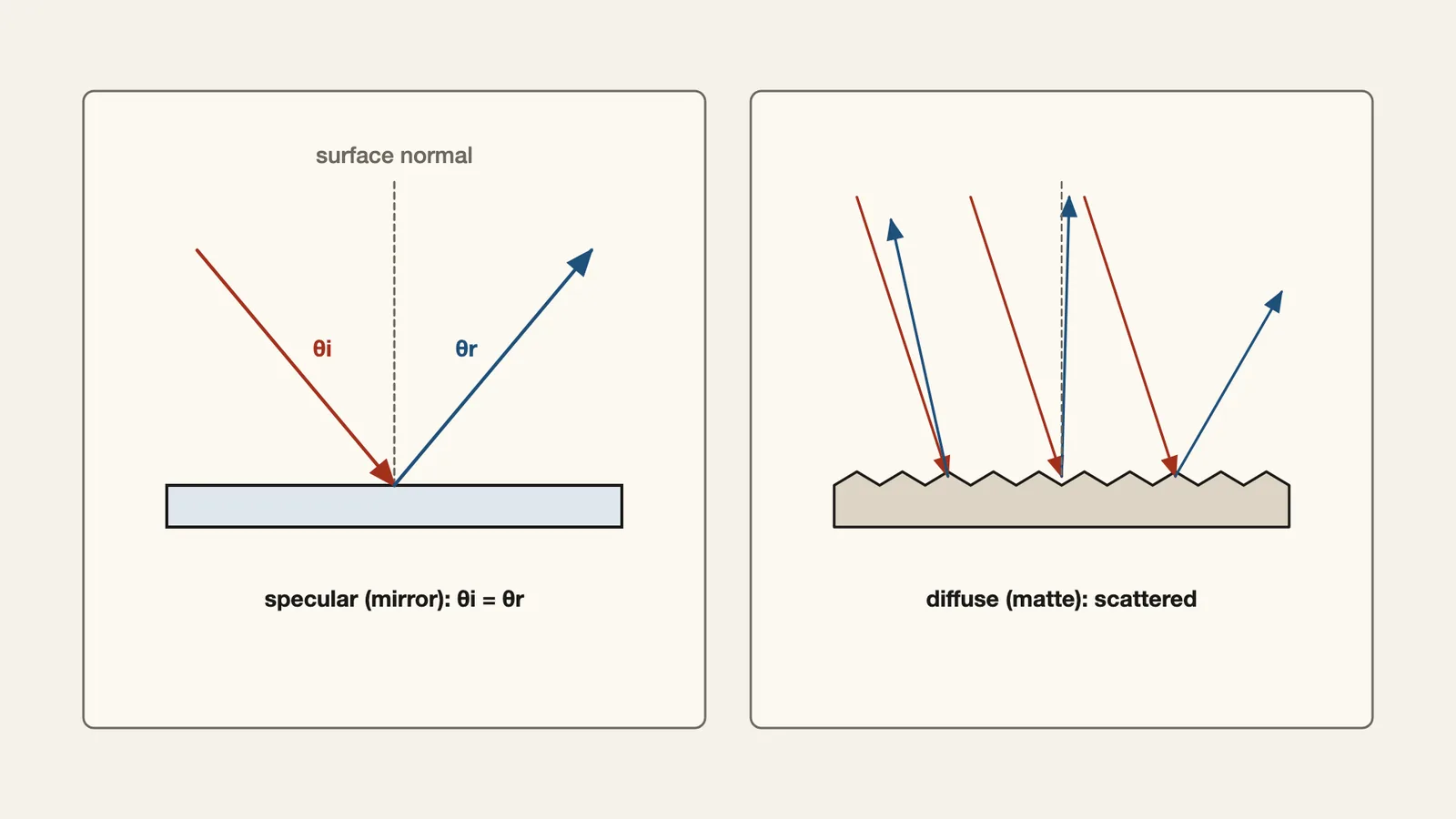
Reflection is the return of light from a surface back into the medium it came from. On smooth surfaces such as mirrors it is specular, with the angle of reflection equal to the angle of incidence; on a rough surface such as paper it is diffuse, scattering light in many directions. Most subjects are seen by reflected light.
5 of 10 free entries left without an account. Create a free account to read without limits.
Meanings
- ImageA mirror image of a scene seen in water, glass or another shiny surface, often used as a compositional device.
How Reflection works in practice
Reflection is the working principle behind bounce cards, reflectors, umbrellas and the white ceiling you aim a speedlight at: each one redirects light so it arrives larger and softer. A white board reflects most light diffusely, silver returns more of it in a harder, specular way, and gold warms the colour. Reflection also causes trouble. Every uncoated air-glass surface sends back about 4% of the light, so a lens with many elements would be dull and full of ghosts without coatings. Glass shop windows, eyeglasses and water reflect the scene behind you; change your angle, flag the light, or use a polarising filter to control them. Light meters assume subjects reflect an average amount, roughly middle grey, so very white or very dark subjects mislead reflected-light metering.
Word origin
From Middle English refleccioun, via Middle French reflexion from Late Latin reflexio, from Latin reflectere "to bend back" (re- "back" + flectere "to bend"). The modern spelling was influenced by the verb reflect; reflexion survived as a British variant.
History
Hero of Alexandria gives the earliest known description of mirror reflection angles.
Ibn al-Haytham (Alhazen) gives a complete statement of the law of reflection.
Harold Dennis Taylor of Cooke develops a chemical method to cut surface reflection from lens glass.
In a sentence
We moved the softbox two steps left so its reflection disappeared from the framed painting.
Questions people ask
How do I remove reflections from glass when taking photos?
Put the lens close to the glass, or use a rubber lens hood pressed against it, so the reflection has nowhere to come from. Dress in dark clothes and switch off lights behind you. If you must shoot at an angle, a circular polariser rotated for maximum effect cuts much of the glare, working best around 56° from perpendicular for ordinary glass.
What is the law of reflection?
For a smooth surface, the angle at which light arrives, measured from a line perpendicular to the surface, equals the angle at which it leaves, and both rays lie in the same plane. Photographers use it to predict where a glare spot or catchlight will appear and where to place a light so its reflection misses the camera.
Sources we checked
Cite this entry
RAP Education Photography School. "Reflection." RAP Dictionary of Photography, Cinema & Visual Arts. https://dictionary.rapeducation.com/term/reflection (accessed 28 November 2026).