Silver halide
noun
A silver halide is a compound of silver with a halogen, most often bromine, chlorine or iodine, giving silver bromide (AgBr), silver chloride (AgCl) and silver iodide (AgI). Microscopic crystals of these salts, held in gelatin, are the light-sensitive ingredient of black-and-white film, photographic paper and unprocessed colour film.
7 of 10 free entries left without an account. Create a free account to read without limits.
How Silver halide works in practice
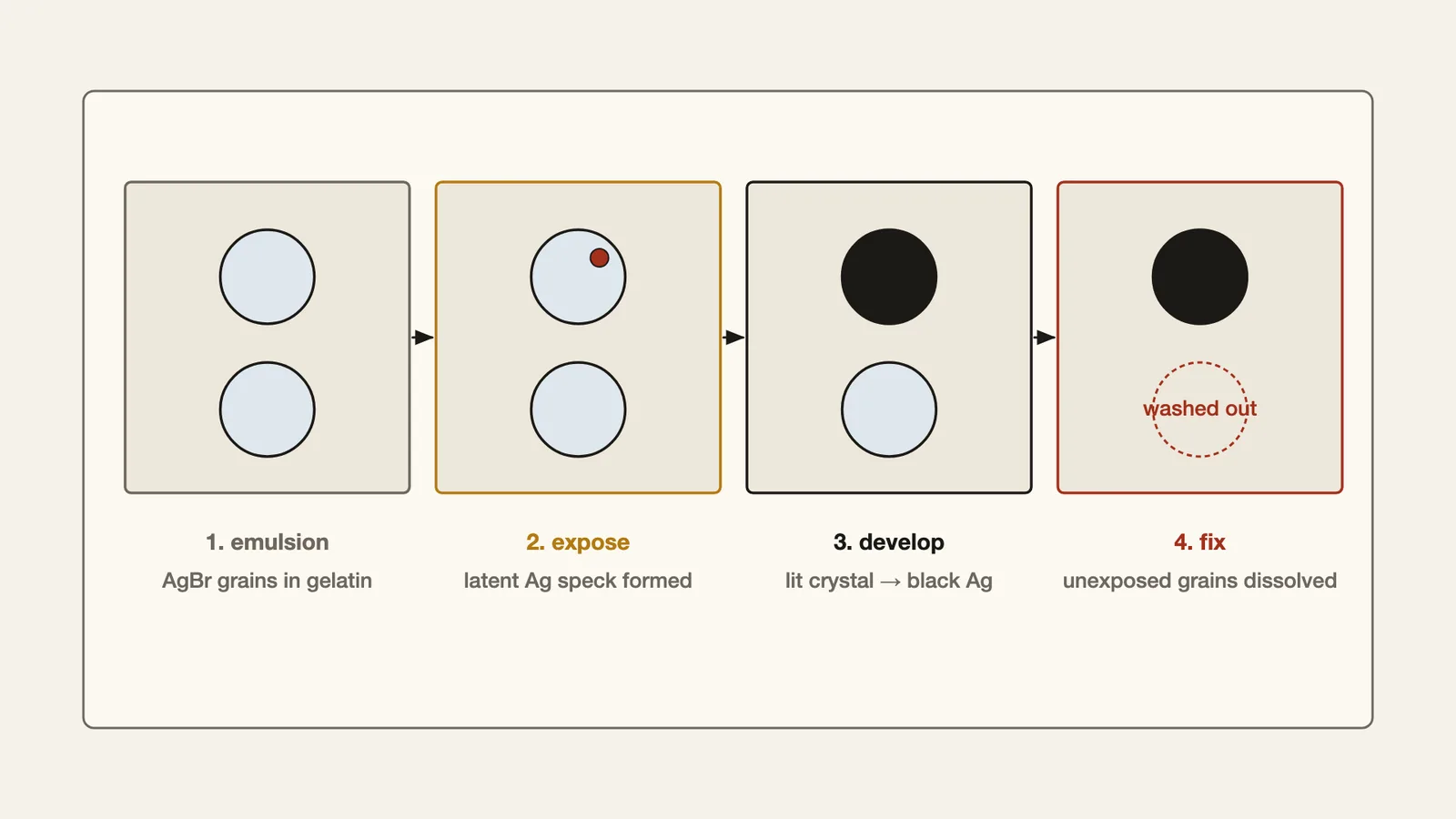
Every roll of film and every sheet of darkroom paper depends on silver halide crystals. Camera films use mainly silver bromide with a small share of iodide, a mix that is fast and well suited to short exposures. Enlarging papers lean on silver chloride or chloro-bromide, which are slower but develop quickly. Light leaves an invisible latent image on the crystals; developer turns the exposed ones into black metallic silver; fixer then dissolves the crystals that were never used. That last step is why fixing must be complete: any halide left in the emulsion stays light-sensitive and can darken or stain later. It also explains darkroom lighting. Printing paper is made far less sensitive to amber or red light than to blue, so a correct safelight lets you work, while panchromatic film responds to all colours and must be handled in total darkness.
Word origin
Halide is formed from halogen plus the chemical suffix -ide. Halogen comes from Greek hals, 'salt', with -gen, 'producing', because these elements form salts when they combine with metals.
History
Johann Heinrich Schulze shows that a chalk mixture containing silver darkens because of light, not heat.
Richard Leach Maddox describes a gelatin emulsion of silver bromide in the British Journal of Photography (8 September).
R. W. Gurney and N. F. Mott publish a theory of how light forms tiny silver specks inside halide crystals.
In a sentence
Fixer removes the unexposed silver halide, so a properly fixed negative no longer reacts to light.
Questions people ask
Why are silver halides sensitive to light?
When light strikes a silver halide crystal it frees electrons, which gather at tiny defects called sensitivity specks. There they combine with silver ions to build a cluster of metallic silver atoms. A cluster of roughly four atoms is enough for a developer to recognise the crystal and convert the whole of it to black silver. Crystals that received no light have no such cluster and develop far more slowly.
Do digital cameras use silver halide?
No. A digital camera records light with a silicon image sensor, an array of photodiodes that turn light into electrical charge, which is then converted to numbers. Silver halide belongs to film, photographic paper and some historical processes. The phrase 'silver halide print' is still used for digital files printed onto traditional light-sensitive colour or black-and-white paper by laser or LED exposure.
Sources we checked
Cite this entry
RAP Education Photography School. "Silver halide." RAP Dictionary of Photography, Cinema & Visual Arts. https://dictionary.rapeducation.com/term/silver-halide (accessed 29 November 2026).