Still life
noun (plural still lifes)
A still life is a picture of inanimate objects, such as fruit, flowers, vessels, books, tools or food, arranged by the artist. In photography the genre gives complete control over subject, placement and light, which makes it a classic training ground and the basis of product and food photography.
4 of 10 free entries left without an account. Create a free account to read without limits.
Meanings
- PaintingThe painting genre of arranged objects that became a distinct specialisation in the Low Countries in the late 16th century, including symbolic vanitas pictures.
How Still life works in practice
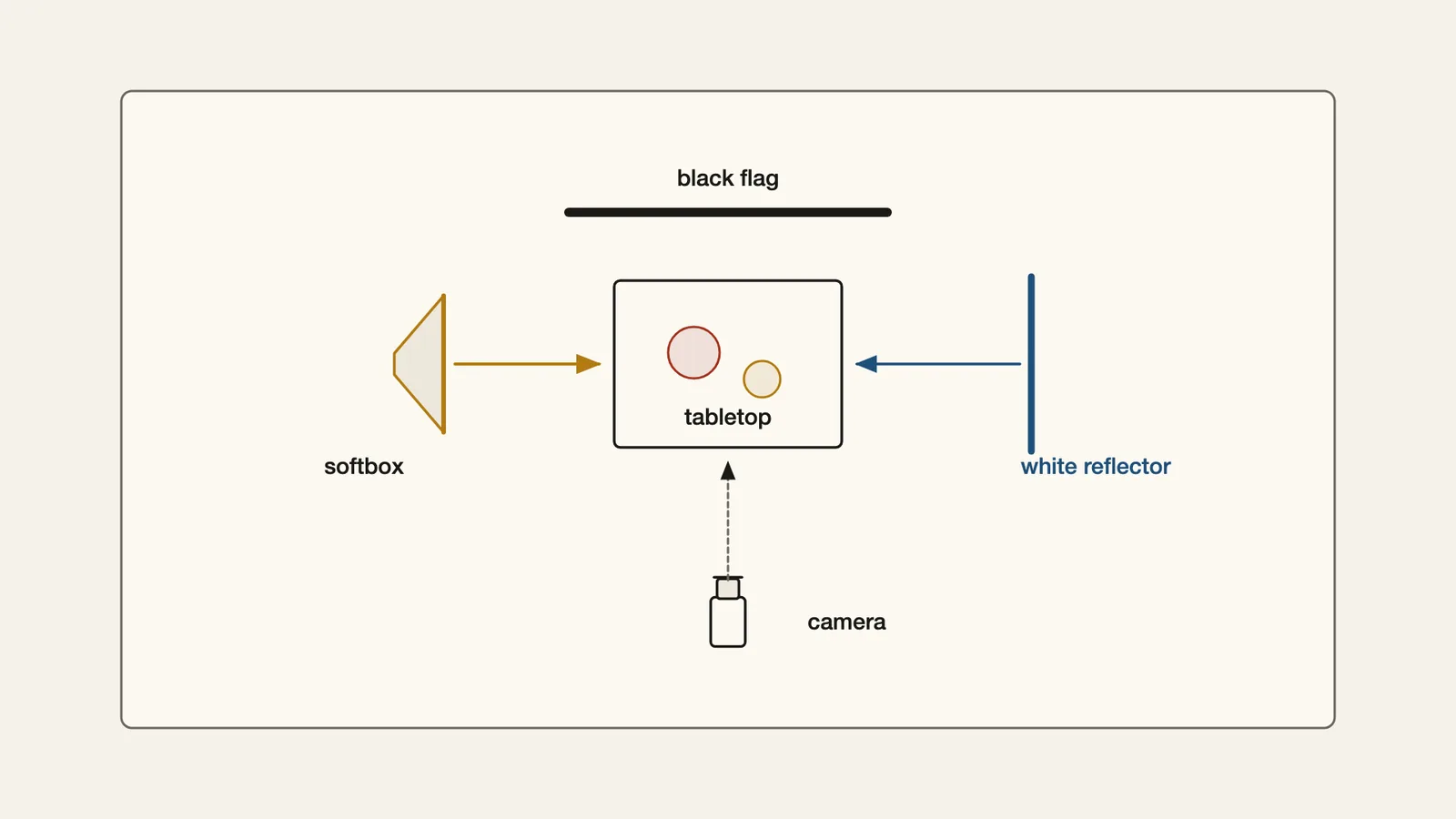
Start with one light. A window or a single softbox to the side, plus a white card reflector on the other side, models shapes and shows texture; a black card deepens shadows for a moodier look. Place the camera on a tripod and use a moderate telephoto, 70–100 mm on full frame, to avoid stretching near objects. Arrange in odd numbers and overlapping layers, and change one object at a time while checking on a laptop screen if you can tether. For deep sharpness on small objects, focus-stack several frames rather than closing down past f/16. Clean every surface with a blower and a microfibre cloth; dust and fingerprints show clearly at full size. Food changes quickly, so prepare the set with stand-in items and bring the real dish in last.
Word origin
A calque of Dutch stilleven, from stil 'motionless, still' + leven 'life'. The Dutch painters' term is recorded by 1678 in Samuel van Hoogstraten's treatise; English 'still life' appears in the 1690s. French and Italian use 'dead nature' instead: nature morte, natura morta.
History
Still life develops as a separate category of painting in the Low Countries.
André Félibien's hierarchy of genres ranks still life at the bottom of academic subject matter.
Still life becomes a fine-art genre in photography; William Henry Fox Talbot makes arranged still-life images.
Karl Blossfeldt publishes Urformen der Kunst, close studies of plant forms linked with New Objectivity.
In a sentence
Her still life of brass lotas and a single marigold used one strip light and a black card.
Questions people ask
Why is it called still life?
The English term copies the Dutch word stilleven, meaning 'still' or 'motionless' plus 'life', which 17th-century Dutch painters used for pictures of arranged objects. Other European languages took a gloomier view: French nature morte and Italian natura morta both mean 'dead nature'. In all cases the idea is the same: the subject does not move.
What is the difference between still life and product photography?
Product photography is a commercial branch of still life. Its main job is to show a specific item clearly and attractively so people will buy it, often on plain backgrounds to a client's specification. Still life as an art genre is freer: objects may carry symbolic meaning, mood, or formal interest, and the photographer decides what the picture is about.
Sources we checked
Cite this entry
RAP Education Photography School. "Still life." RAP Dictionary of Photography, Cinema & Visual Arts. https://dictionary.rapeducation.com/term/still-life (accessed 28 November 2026).