Viewfinder
noun
A viewfinder is the part of a camera you look through or into to frame a picture and judge what will be recorded. It can be optical, showing the scene through the taking lens or a separate window, or electronic, showing a live image from the sensor on a small high-resolution screen inside an eyepiece.
1 of 10 free entries left without an account. Create a free account to read without limits.
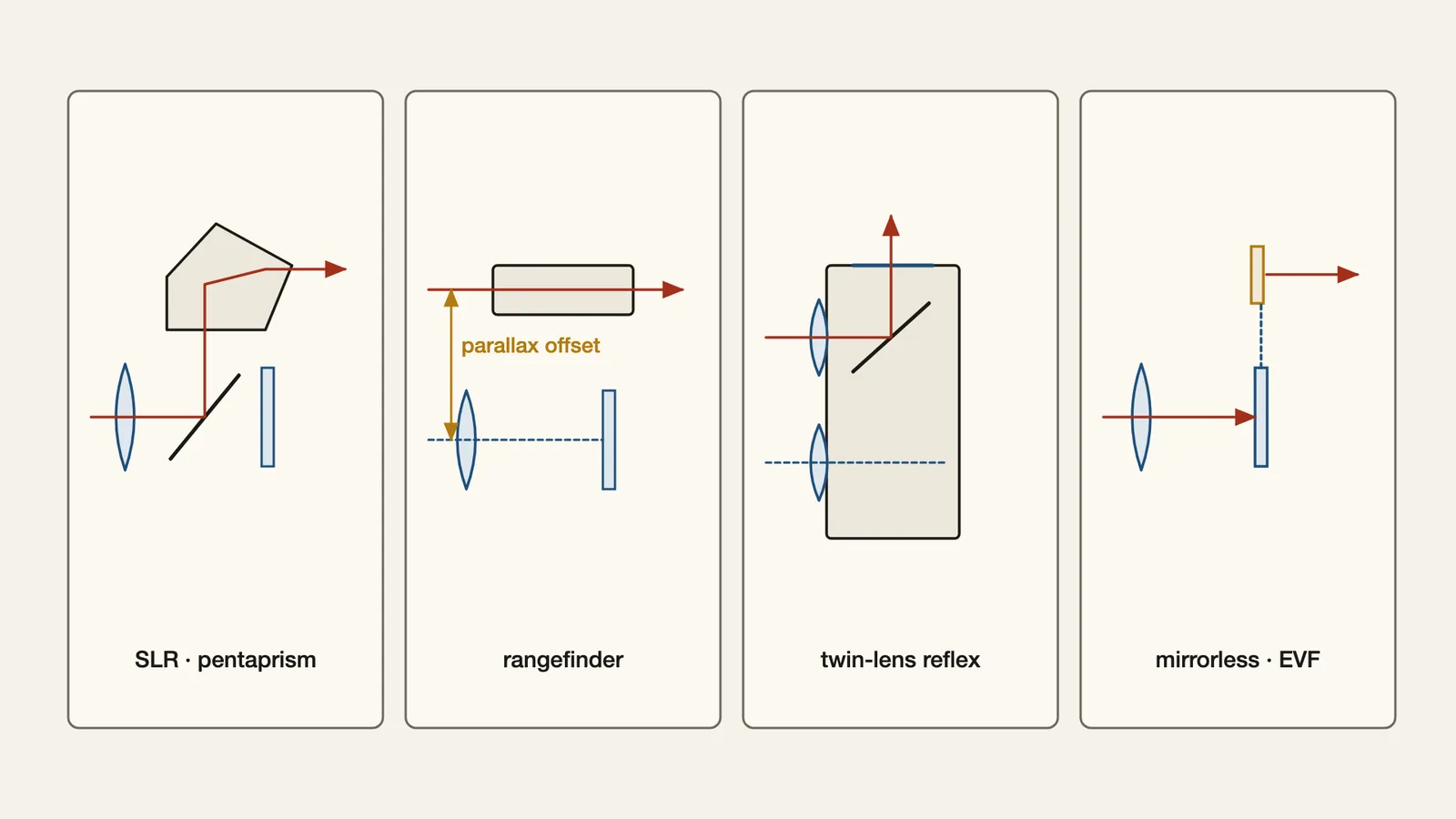
How Viewfinder works in practice
An SLR's optical finder shows the scene through the lens with no lag; a rangefinder or compact finder looks through a separate window, so at close range what you see is offset from what the lens records (parallax). An electronic viewfinder previews exposure and colour and can magnify for manual focus, at the cost of battery and, on older cameras, some lag. Check coverage: a finder showing 95% of the frame lets unseen edges creep into the picture. Set the dioptre wheel once so the information display looks crisp, especially if you remove your glasses. Pressing the camera to your face steadies it compared with holding it at arm's length. On a DSLR during long tripod exposures, close the eyepiece shutter or cover it, since stray light entering the finder can upset metering. Waist-level finders on TLRs show the image reversed left to right.
Word origin
A compound of view, 'what is seen', and finder, an older word for a small auxiliary sight used to find and aim at a subject, also used on telescopes. Merriam-Webster and the OED both record viewfinder from 1883, the OED citing the Photographic News.
History
Rollei introduces the Rolleiflex twin-lens reflex, with ground-glass viewing from above through a matching lens.
Jenő Dulovits patents the first eye-level SLR viewfinder in Hungary on 23 August.
The Contax S enters production with a pentaprism for eye-level SLR viewing.
Fujifilm announces a hybrid optical and electronic viewfinder for its X100 compact.
In a sentence
In the harsh noon sun the rear screen was useless, so she framed every shot through the viewfinder.
Questions people ask
Is an electronic viewfinder as good as an optical one?
They suit different priorities. An optical viewfinder uses no power, never lags and shows the real scene at full resolution. A modern electronic viewfinder shows exposure, white balance and focus aids before you shoot, works in very dim light and can magnify for manual focus. Older or budget EVFs may look grainy or lag with fast action; the best current ones are hard to fault.
What does viewfinder coverage mean?
Coverage is the percentage of the recorded image that you actually see in the viewfinder. At 100% coverage, what you frame is exactly what you get. Many entry-level SLRs showed about 95%, so a few millimetres around the edges were recorded but not seen, letting stray objects slip into the picture. Electronic viewfinders normally show 100% because they display the sensor image.
Sources we checked
Cite this entry
RAP Education Photography School. "Viewfinder." RAP Dictionary of Photography, Cinema & Visual Arts. https://dictionary.rapeducation.com/term/viewfinder (accessed 29 November 2026).