Vitaphone
proper noun
Vitaphone was a sound-on-disc system for motion pictures, developed by Western Electric at Bell Laboratories and used by Warner Bros. and First National from 1926 to 1931. The soundtrack was cut on 16-inch discs played at 33⅓ rpm on a turntable mechanically linked to the projector. It carried Don Juan (1926) and The Jazz Singer (1927).
5 of 10 free entries left without an account. Create a free account to read without limits.
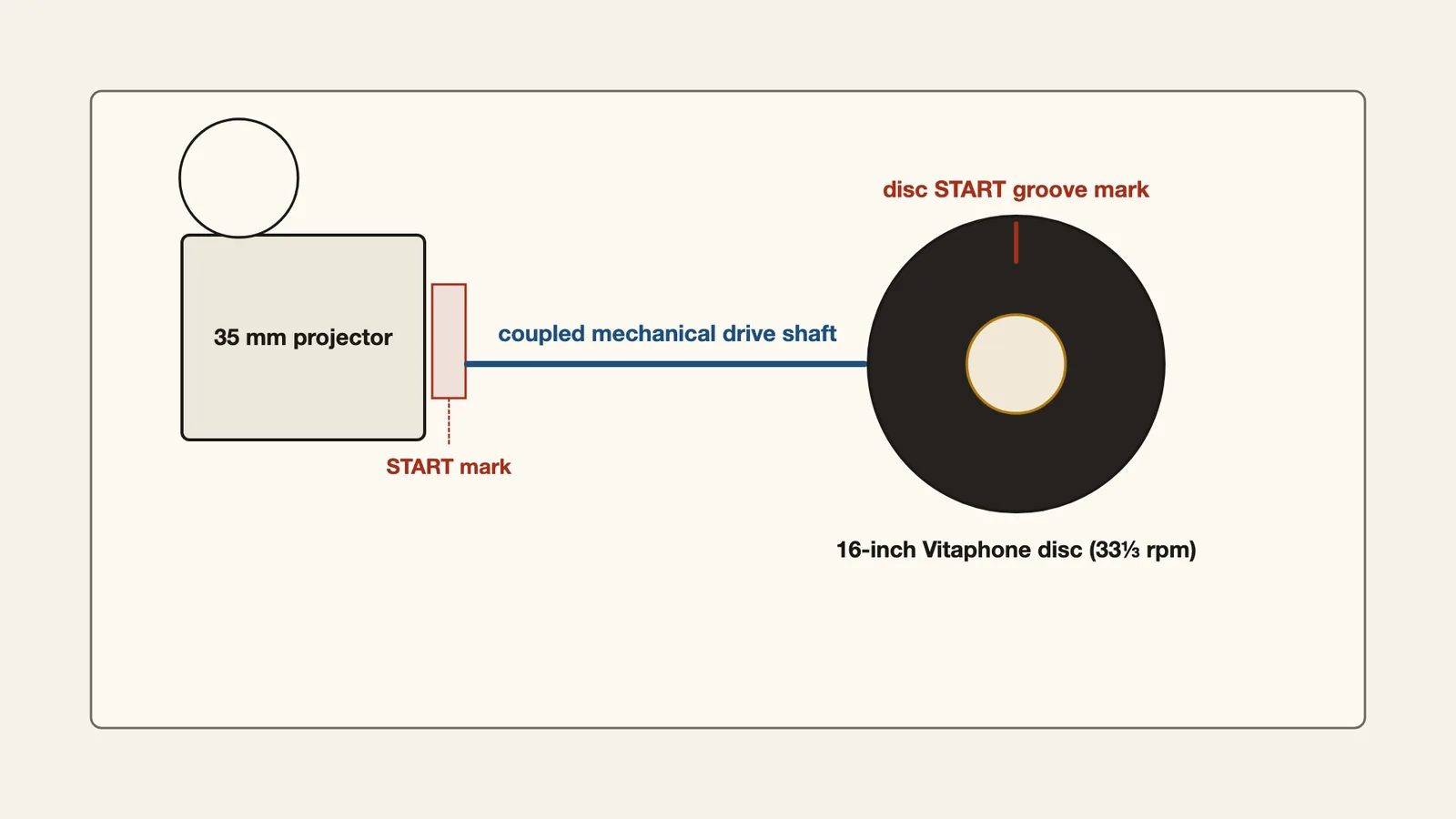
How Vitaphone works in practice
Vitaphone explains several habits of early talkies. Each reel of film originally had its own disc, about 11 minutes long, and picture and sound had to start together from marked points. If a damaged print was not repaired precisely, sync was lost, and projectors could correct it only within narrow limits. Editing was awkward too: a disc could not be cut like film, so picture reels were conformed to the sound by adding or removing frames at edit points. These limits are why sound-on-film, with the soundtrack printed beside the image, won out; by mid-1931 Warner was recording optical sound and only copying it to discs. For archivists, Vitaphone is a preservation puzzle: many films survive as picture without discs, or discs without picture. The Vitaphone Project, started in 1991, has located thousands of soundtrack discs and helped restore many shorts and features by reuniting them with their images.
Word origin
Coined from Latin vita 'life' and Greek phōnē 'sound, voice', suggesting 'living sound'.
History
Warner Bros. acquires the Western Electric/Bell Labs sound-on-disc system in April.
Vitaphone is introduced on 5 August with Don Juan, which has a recorded score and effects.
The Jazz Singer premieres on 6 October.
By mid-year Warner records sound optically on film, dubbing to disc only for theatres that still need it.
The Vitaphone Project begins locating surviving soundtrack discs.
In a sentence
The restorers matched a surviving Vitaphone disc to the picture negative and brought the 1928 short back into sync.
Questions people ask
What is the difference between sound-on-disc and sound-on-film?
Sound-on-disc systems such as Vitaphone recorded audio on separate phonograph discs played in sync with the projector. Sound-on-film systems printed the soundtrack as an optical track along the edge of the film itself, so picture and sound could not drift apart and could be edited together. Sound-on-film became the industry standard by the early 1930s.
Was Vitaphone used for The Jazz Singer?
Yes. Warner Bros.' The Jazz Singer, which premiered on 6 October 1927, used Vitaphone discs for its synchronised songs and brief spoken passages. Its success is traditionally credited with launching the talkie era, although most of the film still relied on music and intertitles.
Sources we checked
Cite this entry
RAP Education Photography School. "Vitaphone." RAP Dictionary of Photography, Cinema & Visual Arts. https://dictionary.rapeducation.com/term/vitaphone (accessed 29 November 2026).