Waxed paper negative
noun
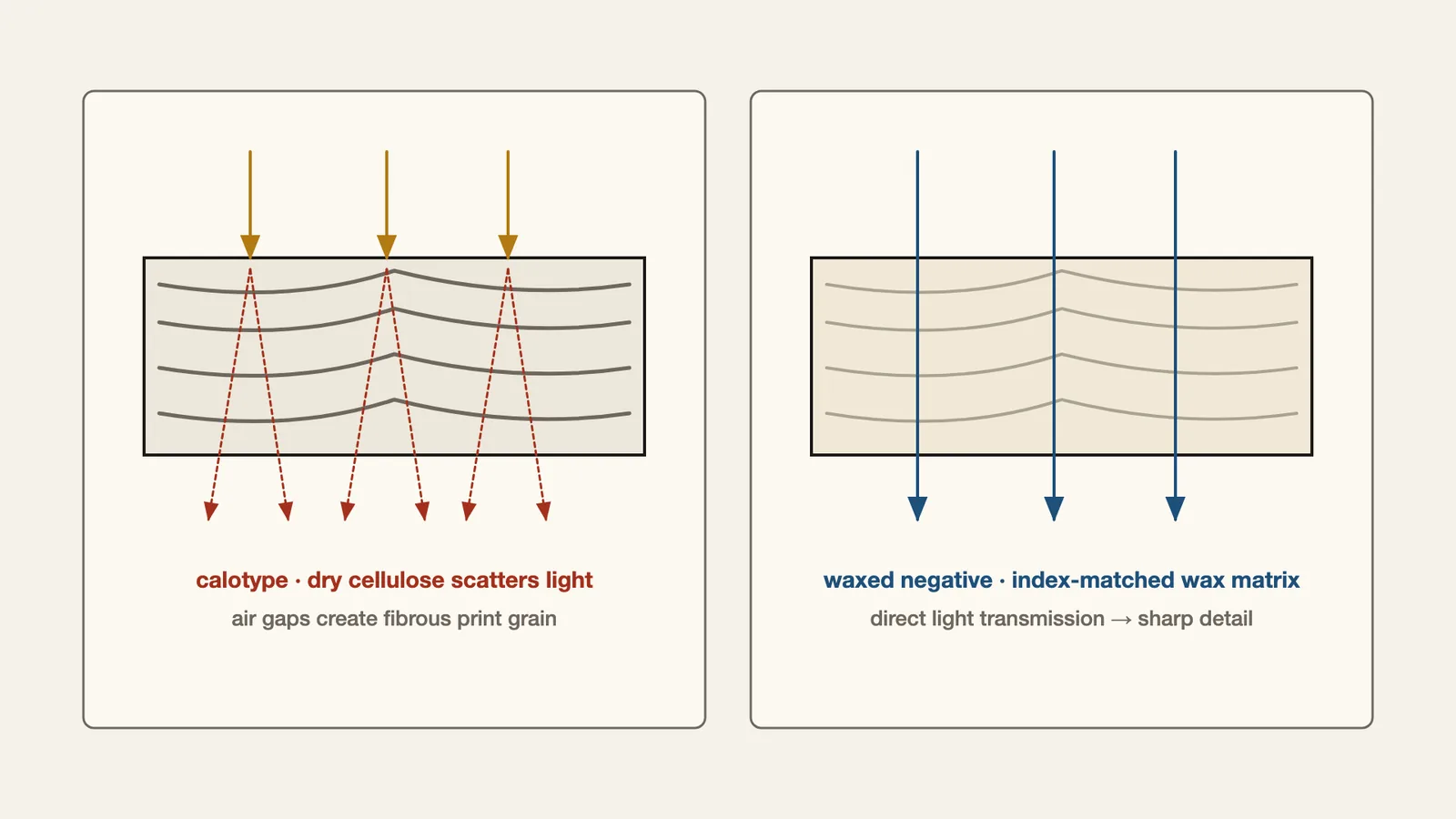
A waxed paper negative is a 19th-century paper camera negative made by soaking the paper in wax before it was iodised and sensitised with silver nitrate. Gustave Le Gray presented the method in Paris in 1851. The wax made the paper more translucent and less fibrous in the image, giving sharper negatives than Talbot's calotype.
8 of 10 free entries left without an account. Create a free account to read without limits.
How Waxed paper negative works in practice
For a museum visitor or archivist, the waxed paper negative explains why some 1850s architectural and landscape prints, especially French ones, are crisper than earlier calotype work. The steps were: impregnate thin, even paper with warm wax; iodise or salt it; store it; sensitise it with silver nitrate; expose; develop in gallic acid, which could take about an hour; then fix. Because the paper could be prepared in advance and developed later, it suited travel, though it struggled in very hot climates where the wax softened. When you handle one, expect it to look flat grey in reflected light and show its image clearly only against light; creases and dents appear white, and retouching is usually pencil or ink, since other media will not stick to wax. Prints from these negatives are typically salted paper or albumen prints.
Word origin
Descriptive English: the paper was 'waxed' before it became a 'negative'. 'Negative' in the photographic sense was introduced by Sir John Herschel in 1840. Contemporary French usage also called these negatives céroléines, from Latin cera, 'wax'.
History
Talbot patents the calotype; finished calotype negatives were sometimes waxed after processing to make them more translucent for printing.
Gustave Le Gray presents the waxed paper process to the French Académie des Sciences, waxing the paper before sensitising.
Photographers of the Mission Héliographique, Le Gray among them, survey French historic monuments using paper negatives.
Towler's manual The Silver Sunbeam still describes Le Gray's waxed paper process as the most widely used refinement of the calotype.
In a sentence
The archive's 1852 view of the cathedral came from a waxed paper negative, which explains its surprising sharpness.
Questions people ask
How is a waxed paper negative different from a calotype?
Both are paper negatives developed with gallic acid and silver. In Talbot's calotype, wax was applied, if at all, after the negative was finished. Le Gray waxed the paper before sensitising, so the wax filled the fibres during exposure, which reduced light scatter and gave sharper detail, and the paper could be prepared well before use.
Who invented the waxed paper negative?
The French photographer Gustave Le Gray, who had trained as a painter under Paul Delaroche, introduced the method to the Académie des Sciences in Paris in 1851. It became the most popular improvement on the calotype in the 1850s.
Sources we checked
Cite this entry
RAP Education Photography School. "Waxed paper negative." RAP Dictionary of Photography, Cinema & Visual Arts. https://dictionary.rapeducation.com/term/waxed-paper-negative (accessed 28 November 2026).