Wide-angle lens
noun
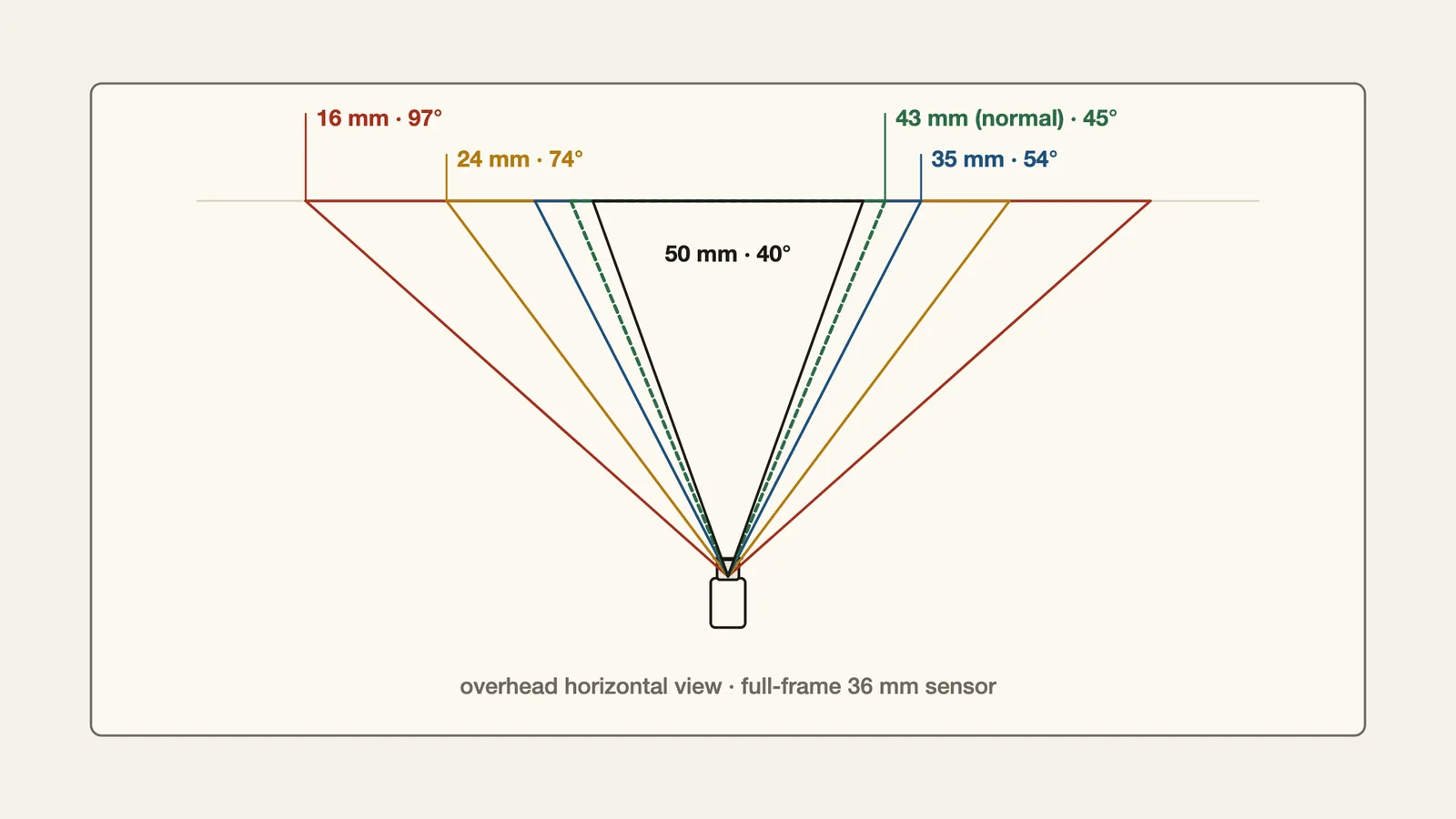
A wide-angle lens is a lens whose focal length is clearly shorter than the diagonal of the sensor or film it covers, so it takes in a broader view than a normal lens. On full-frame 35 mm that usually means 35 mm or shorter; lenses below 24 mm are generally called ultra-wide.
7 of 10 free entries left without an account. Create a free account to read without limits.
How Wide-angle lens works in practice
Wide lenses (24, 28 or 35 mm on full frame; about 16–24 mm on APS-C) fit a cramped room, a busy street or a big sky into one frame. They also stretch apparent distance: a hand reaching toward a 20 mm lens looks enormous, and a face shot from 40 cm gains a bigger nose, so keep portrait subjects back and near the centre. Tilting the camera up makes buildings lean backward far more than with a normal lens; keep the camera level and crop later, or use a shift lens. Strong foreground interest matters, because an empty wide frame feels flat. Depth of field is generous, which helps landscapes and handheld video. On cheaper designs check for barrel distortion, soft corners and dark corners. The stretched look of objects at the frame edges is a property of rectilinear projection, not a fault you can fix by buying a better lens.
Word origin
A compound of wide and angle, referring to the broad angle of view such lenses cover. Merriam-Webster records the adjective wide-angle from 1865, used especially of lenses of shorter than normal focal length.
History
Thomas Sutton patents a water-filled spherical panoramic lens on 28 September, one of the earliest wide-angle photographic lenses.
Angénieux's Retrofocus 35 mm f/2.5 becomes the first retrofocus wide-angle lens for 35 mm SLRs, leaving room for the reflex mirror.
In a sentence
In the tiny kitchen only a wide-angle lens could show both the cook and the window behind her.
Questions people ask
Why do faces look distorted with a wide-angle lens?
Because you have to stand close to fill the frame. At short distances the nose is proportionally much nearer the camera than the ears, so it renders larger; this is perspective set by distance, not a fault of the glass. Faces near the frame edges are also stretched by rectilinear projection. Step back and keep the face central, or use a longer lens for portraits.
What is the difference between a wide-angle and a fisheye lens?
A normal wide-angle lens is rectilinear: it keeps straight lines in the scene straight in the picture, at the cost of stretching objects near the corners. A fisheye deliberately bends straight lines that do not pass through the centre, which lets it show 180 degrees or more. Fisheyes look strongly curved; rectilinear wides look natural until the edges.
Sources we checked
Cite this entry
RAP Education Photography School. "Wide-angle lens." RAP Dictionary of Photography, Cinema & Visual Arts. https://dictionary.rapeducation.com/term/wide-angle-lens (accessed 28 November 2026).