Yousuf Karsh
proper noun (person)
Yousuf Karsh (1908–2002) was an Armenian-Canadian portrait photographer, based in Ottawa, famous for dramatically lit studio portraits of world leaders, artists and scientists. His 1941 portrait of Winston Churchill, The Roaring Lion, made his name and is often called the most reproduced portrait in the history of photography.
5 of 10 free entries left without an account. Create a free account to read without limits.
How Yousuf Karsh works in practice
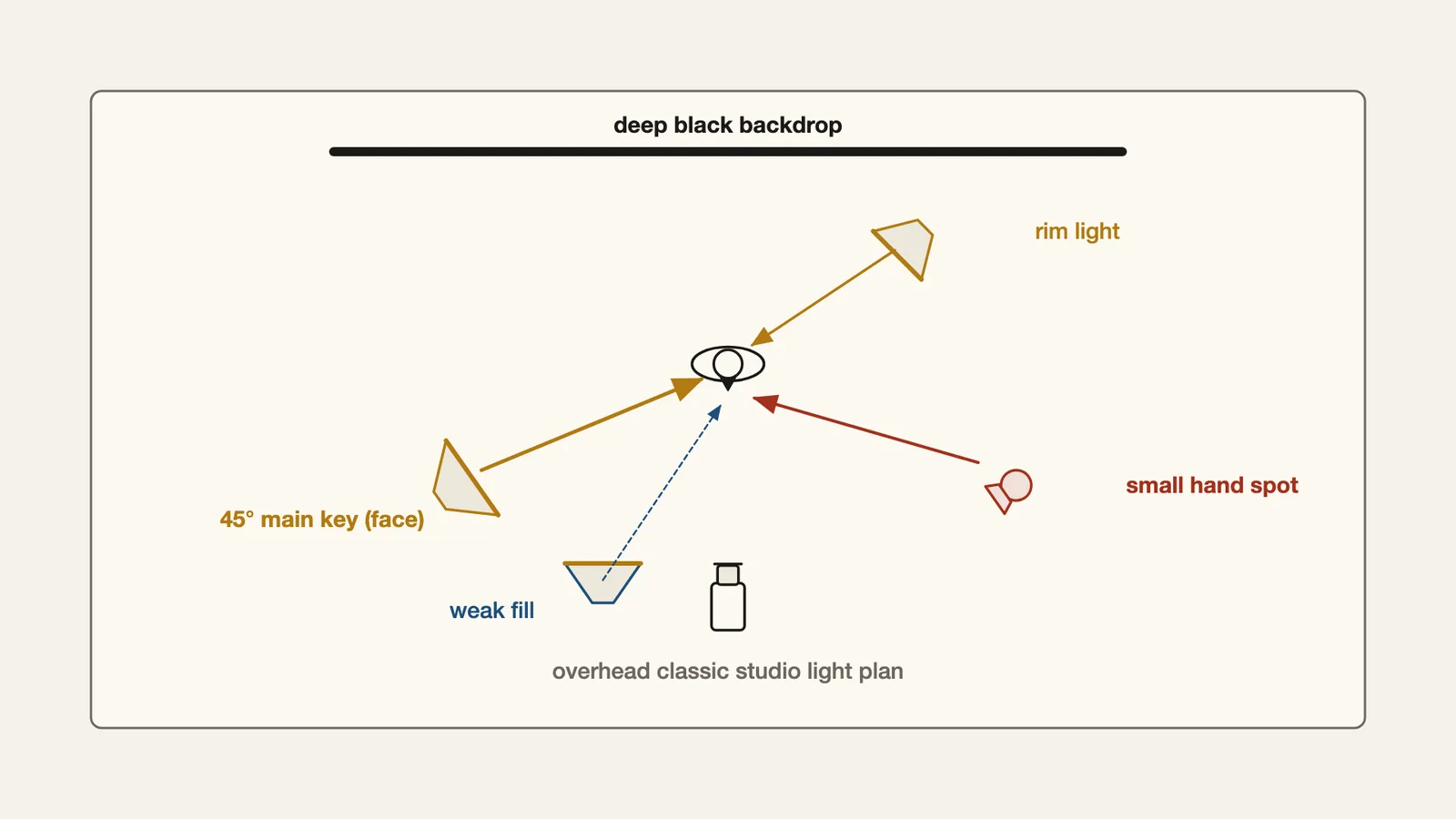
Karsh is the standard example of theatrical portrait lighting. He learned it partly at the Ottawa Little Theatre, and it shows: a dark background, a hard or controlled key that carves the face, separate lights on the hands and a rim to lift the shoulders off the background. To study his method, set a single focused key high and to one side, add a dim fill so shadows keep detail, light the hands separately, and print or grade dark so the face and hands glow. He also prepared: he researched each sitter and talked with them before shooting, then waited for an expression that suited their public role. The Churchill sitting shows the human side of that skill. Churchill refused to put down his cigar, Karsh took it from his mouth, and the scowl that followed became the picture.
History
Born on 23 December in Mardin, in the Ottoman Empire (now Turkey), to Armenian parents.
Arrives in Canada as a refugee and trains with his uncle George Nakash, a portrait photographer in Sherbrooke, Quebec.
Apprentices with the portrait photographer John H. Garo in Boston.
Opens his first studio in Ottawa, at 130 Sparks Street.
Photographs Winston Churchill on 30 December in the Canadian Parliament in Ottawa.
The Churchill portrait appears on the cover of Life on 21 May.
Retires; over his career more than 20 of his photographs had appeared on Life covers.
Dies on 13 July.
In a sentence
For the actor's headshot we went for a Yousuf Karsh look: black background, one hard key and the hands lit separately.
Questions people ask
How did Yousuf Karsh get the famous Churchill photograph?
On 30 December 1941, after Churchill addressed the Canadian Parliament, Karsh had a few minutes with him in the Speaker's Chamber. Churchill would not remove his cigar, so Karsh stepped forward, took it from his mouth and made the exposure. The annoyed, defiant expression became the image known as The Roaring Lion.
What lighting did Karsh use?
He used studio and theatrical lighting rather than daylight: a controlled, often hard key light to model the face, separate lights for hands and clothing, rim or background lights for separation, and dark backgrounds. The result is high contrast with strong shadow areas, close in spirit to chiaroscuro painting.
Sources we checked
Cite this entry
RAP Education Photography School. "Yousuf Karsh." RAP Dictionary of Photography, Cinema & Visual Arts. https://dictionary.rapeducation.com/term/yousuf-karsh (accessed 28 November 2026).