Diffraction
noun
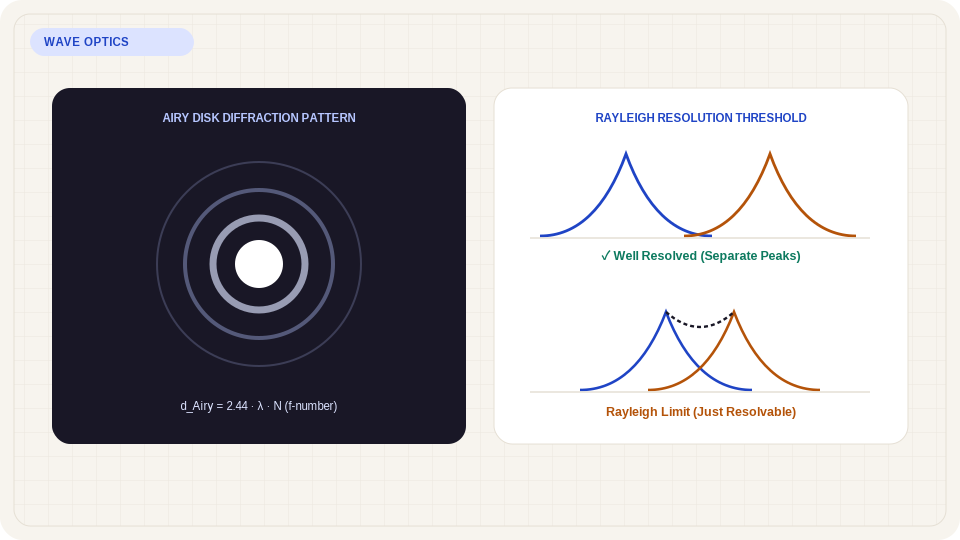
Diffraction is the spreading and bending of light waves as they pass an edge or go through an opening. The smaller the opening compared with the wavelength, the stronger the spread. In cameras, diffraction at the aperture turns each point of light into a tiny blur disc, which softens images at small apertures.
1 of 10 free entries left without an account. Create a free account to read without limits.
How Diffraction works in practice
Stop a lens down to gain depth of field and you eventually lose sharpness to diffraction. The blur spot's diameter is roughly 2.44 × wavelength × f-number: about 10.7 micrometres at f/8 and 21.5 micrometres at f/16 for green light, compared with pixel pitches of about 4 to 6 micrometres on many current sensors. On such cameras the softening becomes visible somewhere around f/8 to f/11, and f/22 looks noticeably mushy. The practical rule: use the lens's sweet spot, often two to three stops down from wide open, and use focus stacking rather than f/22 when you need front-to-back sharpness. Diffraction also has a pleasing side. The straight edges of aperture blades create sunstars: six blades give six points, while seven blades give fourteen, because odd counts do not overlap.
Word origin
Coined in New Latin as diffractio by the Italian Jesuit scientist Francesco Maria Grimaldi, from diffractus, past participle of diffringere "to break into pieces" (dis- + frangere "to break"). His book Physico-mathesis de lumine, published in 1665, introduced the term.
History
Grimaldi's Physico-mathesis de lumine names and describes diffraction.
Thomas Young's Lectures include his two-slit wave sketches, supporting the wave theory.
George Biddell Airy publishes the full theory of diffraction by a circular aperture.
In a sentence
At f/22 diffraction had erased the fine texture in the sandstone, so we reshot at f/11 and stacked three frames.
Questions people ask
At what aperture does diffraction become a problem?
It depends on pixel size and print size. On many full-frame cameras of 24 to 45 megapixels, softening starts to show around f/8 to f/11 when you inspect at 100%, and becomes obvious by f/16 to f/22. Smaller sensors with smaller pixels show it at wider apertures. For prints viewed normally, f/11 or f/16 can still look perfectly sharp.
Why do sunstars have different numbers of points?
Each straight edge of the aperture diaphragm diffracts light into two opposite spikes. With an even number of blades, opposite spikes overlap, so six blades give six points. With an odd number they do not overlap, so seven blades give fourteen points and nine give eighteen. Rounded blades and wide apertures weaken the effect.
Sources we checked
Cite this entry
RAP Education Photography School. "Diffraction." RAP Dictionary of Photography, Cinema & Visual Arts. https://dictionary.rapeducation.com/term/diffraction (accessed 28 November 2026).