Interference (optics)
noun
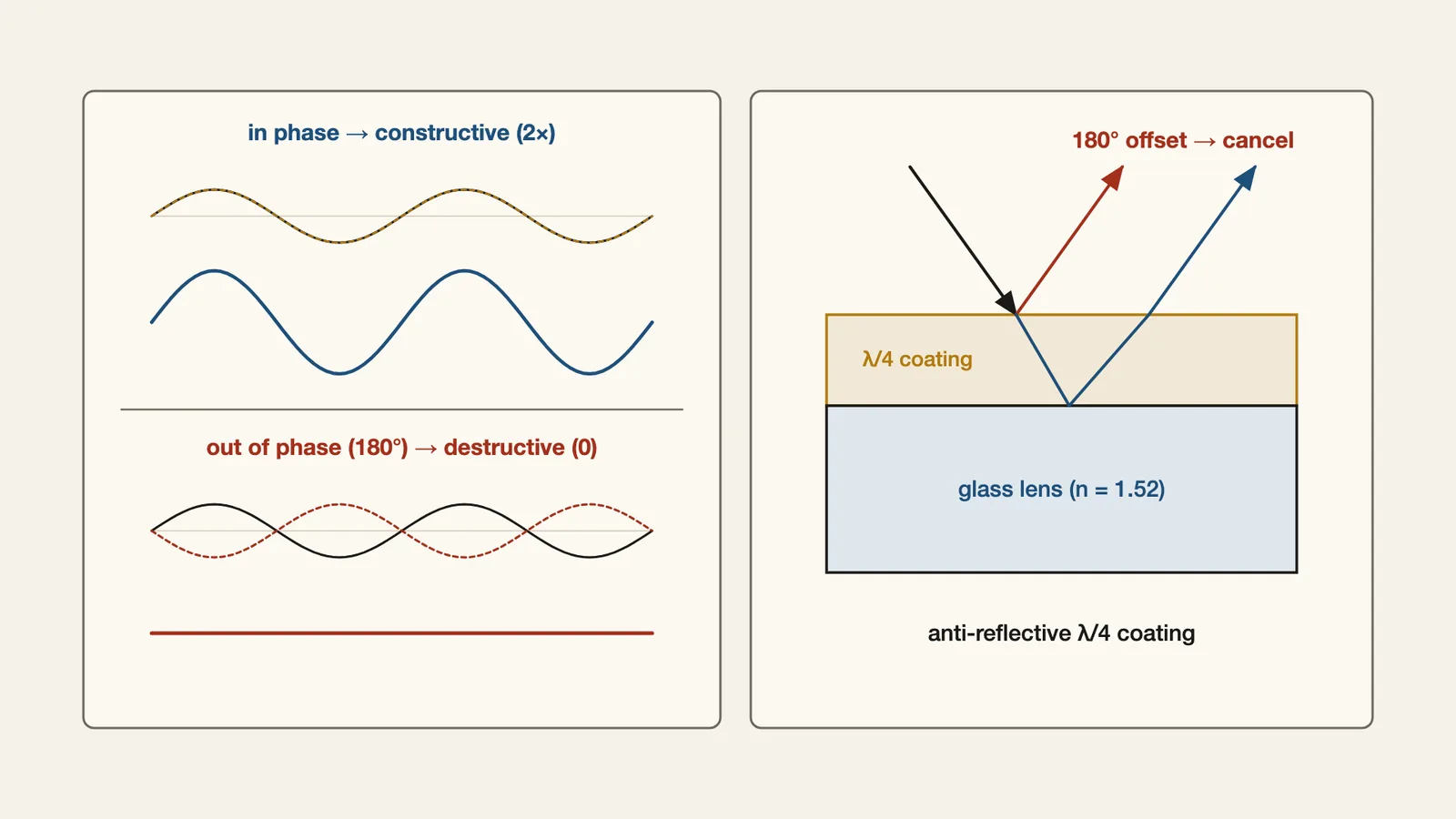
Interference, in optics, is what happens when two or more light waves overlap and add together. Where crests meet crests they reinforce each other (constructive interference); where crests meet troughs they cancel (destructive interference). The result is a pattern of bright and dark bands, or of colours when white light is involved.
9 of 10 free entries left without an account. Create a free account to read without limits.
Meanings
- Electronics and broadcastingUnwanted signals that disturb a radio, video or audio transmission, such as RF hum on a microphone line; a different usage from optical interference.
How Interference (optics) works in practice
Interference is working on almost every modern lens. Anti-reflection coatings are films roughly a quarter of a wavelength thick, chosen so light bouncing off the top and bottom of the film cancels out; a single magnesium fluoride layer cuts reflection from about 4% to about 1% per surface, and multi-layer stacks go further. The faint green, purple or amber tint you see on a front element is the reflected light the coating could not cancel. Dichroic filters, hot mirrors and many colour-correction filters in LED fixtures use stacked interference layers to reflect some wavelengths and pass others. Interference can also spoil work: when film or a print touches glass in a scanner or enlarger carrier, a thin air gap produces rainbow Newton's rings, which is why anti-Newton glass has a slightly textured surface.
Word origin
From interfere + -ence; interfere comes via Old French s'entreferir "to strike each other". The physical sense is credited to Thomas Young, who used it as early as 1801 in a paper in the Philosophical Transactions of the Royal Society.
History
Robert Hooke describes the coloured rings later named after Newton in Micrographia.
Thomas Young applies the word interference to overlapping light waves.
Gabriel Lippmann receives the Nobel Prize in Physics for colour photography based on interference.
Olexander Smakula at Zeiss develops interference-based anti-reflection lens coatings.
In a sentence
The rainbow rings across the negative were interference from the air gap between film and scanner glass.
Questions people ask
How do lens coatings use interference?
A coating is a transparent layer about a quarter of a wavelength thick. Light reflected from its top surface and from the glass beneath travel paths that differ by half a wavelength, so the two reflections cancel. Less light is reflected, more passes into the lens, and flare and ghosting drop. Multi-layer coatings stack several such films to work across more of the spectrum.
What causes Newton's rings in scanned film?
When film lies against glass, the air gap between them varies in thickness by fractions of a wavelength. Light reflected at the top and bottom of that gap interferes, creating concentric rainbow rings or blotches. Using anti-Newton glass, a glassless carrier, or a fluid-mount scanner breaks up the thin uniform gap and prevents the pattern.
Sources we checked
Cite this entry
RAP Education Photography School. "Interference (optics)." RAP Dictionary of Photography, Cinema & Visual Arts. https://dictionary.rapeducation.com/term/interference (accessed 28 November 2026).