Pixel
noun
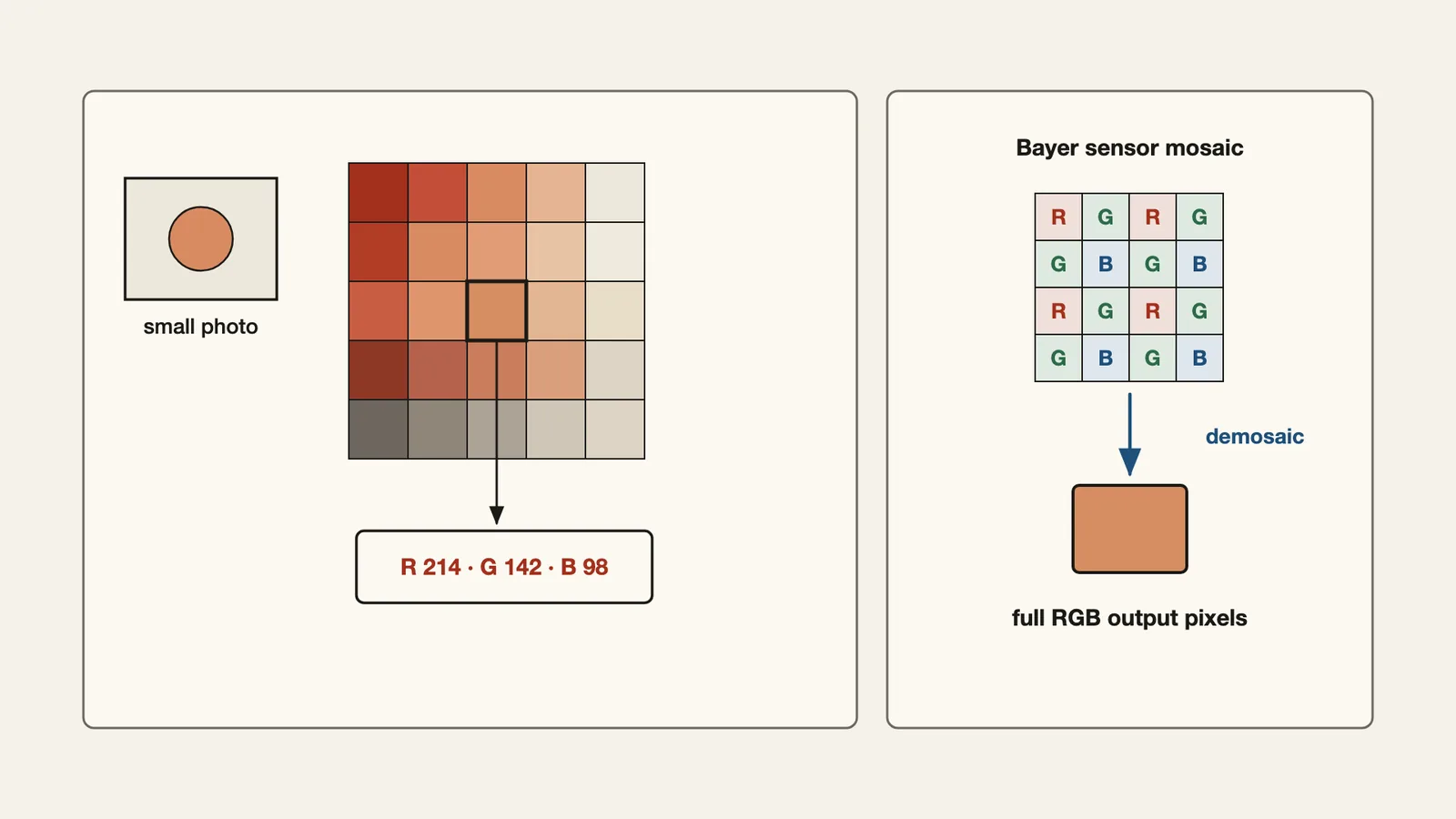
A pixel is the smallest addressable unit of a raster image: one sample that stores a value for brightness and, in colour images, for red, green and blue. Pixels sit in a grid, and their count across and down sets an image's resolution. The word also names the dots on a screen and, loosely, the photosites on a sensor.
3 of 5 free entries left without an account. Create a free account to read without limits.
Meanings
- Image fileOne stored sample in a digital picture, with no physical size of its own until it is displayed or printed.
- DisplayOne controllable dot on a monitor or phone screen, usually built from red, green and blue subpixels.
- Camera sensor (loose use)Manufacturers call each light-sensitive photosite a pixel, although on a Bayer sensor each one records a single colour and full-colour pixels are made later by demosaicing.
How Pixel works in practice
A 6000 × 4000 file holds 24 million pixels, which is what a 24 MP camera spec means. Pixels have no size on their own: the same file printed at 300 ppi is 20 × 13.3 inches, and at 150 ppi it doubles to 40 × 26.7 inches. Bit depth decides how many values each pixel can hold; an 8-bit JPEG gives 256 levels per channel, a 14-bit raw file 16,384. When you zoom to 100% in an editor, one image pixel maps to one screen pixel, which is the honest view for judging focus and noise. Enlarging in software (upsampling) invents new pixels by interpolation, so it cannot add real detail. Video specs work the same way: 3840 × 2160 UHD is about 8.3 million pixels per frame. Some formats, like old DV and anamorphic video, use non-square pixels that must be stretched on playback.
Origin & history
A blend of pix, a clipped plural of 'picture' (pics), and el, from 'element'; it is short for 'picture element'. German engineers had used Bildpunkt ('picture point') in the 1880s, and 'picture element' appears in English patents from the 1910s.
Paul Nipkow's German television patent uses Bildpunkt, 'picture point', for one element of a scanned image.
'Picture element' appears in Wireless World, one of its earliest published uses.
Frederic C. Billingsley of JPL publishes the word 'pixel' for picture elements of space-probe images.
In a sentence
At 100% view, the sharpest pixels sat on her eyelashes, not on the iris, so the focus had slipped by a few millimetres.
Questions people ask
Is a pixel the same as a photosite?
Not strictly. A photosite is the physical light-collecting well on a sensor, and on most cameras it records only red, green or blue through a filter. A pixel is a sample in the finished image with full colour values, computed from neighbouring photosites during demosaicing. Camera brands still call photosites pixels, so a '24 MP sensor' means about 24 million photosites.
How big is a pixel?
A pixel in a file has no physical size. It only gains one when shown or printed. Printed at 300 pixels per inch, each pixel is about 0.085 mm wide; on a 27-inch 4K monitor each screen pixel is roughly 0.16 mm. On sensors, the spacing between photosites, called pixel pitch, is usually a few micrometres: smaller on phones, larger on low-resolution full-frame cameras.
Do more pixels always mean a better picture?
No. More pixels allow bigger prints and more cropping, but sharpness also depends on the lens, focus, camera shake and diffraction. Smaller photosites packed onto the same sensor area can also show more noise per pixel in low light, although the difference shrinks when images are compared at the same output size.
Sources we checked
Cite this entry
RAP Education Photography School. "Pixel." Lexiton, by RAP Education Photography School. https://dictionary.rapeducation.com/term/pixel (accessed 29 November 2026).