Resolution
noun
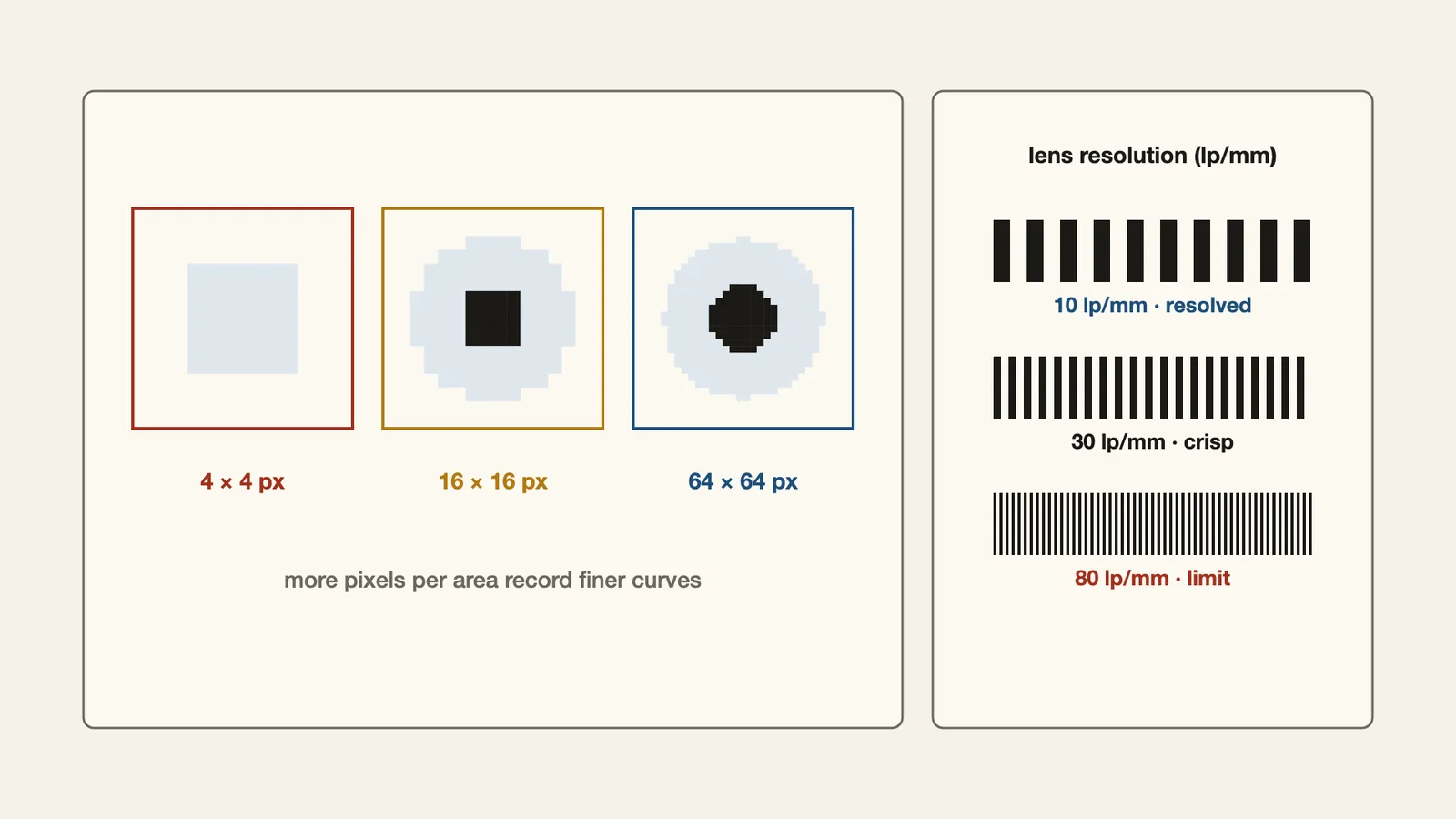
Resolution is the amount of fine detail an image or imaging system can record or show. In everyday digital use it means pixel dimensions, such as 6000 × 4000 pixels (24 megapixels). Strictly, it measures how closely spaced lines can be while still being seen as separate, which depends on the lens and sensor together.
4 of 5 free entries left without an account. Create a free account to read without limits.
Meanings
- OpticsResolving power: the smallest separation at which a lens or instrument distinguishes two points or lines, often given in line pairs per millimetre.
- Display and printPixel density, measured in pixels per inch (ppi) on screens and files, or dots per inch (dpi) for printer output.
How Resolution works in practice
Pixel count sets the upper limit, not the result. To estimate print size, divide pixel width by 300 for close viewing: a 6000-pixel-wide file prints about 20 inches wide at 300 ppi, or about 40 inches at 150 ppi for wall viewing. Video uses fixed resolutions such as 1920 × 1080 (Full HD) and 3840 × 2160 (4K UHD). Actual detail drops through camera shake, missed focus, a soft lens, a low-pass filter, heavy noise reduction or diffraction at very small apertures, so a sharp 12-megapixel file can out-resolve a blurred 45-megapixel one. Do not upscale small files and assume detail has been added; interpolation and AI upscaling invent or smooth pixels. Changing the ppi number in a file's metadata alone changes print size, not the image itself.
Origin & history
From Latin resolutio 'a loosening, solution', from resolvere 'to loosen, undo' (re- + solvere). It is recorded in English from the late 14th century. The optical sense, an instrument making the parts of an object distinguishable, appears by 1860, from the earlier sense of separating something into its components.
The optical sense of resolution, rendering parts of an object distinguishable, is attested in English.
In a sentence
The resolution was plenty for a poster, but slight camera shake meant the eyes were not sharp.
Questions people ask
How many megapixels do I need?
Fewer than marketing suggests. A 12-megapixel file prints well at about 13 × 10 inches at 300 ppi and looks fine much larger on a wall. Twenty to 24 megapixels suit almost all professional jobs, including magazine spreads. Higher counts, 45 megapixels and above, help with heavy cropping, large fine-art prints and architecture, but they demand better lenses, steadier technique and more storage.
What is the difference between ppi and dpi?
Ppi (pixels per inch) describes how densely a digital image's pixels are spread when printed or displayed. Dpi (dots per inch) describes how many ink dots a printer lays down, and an inkjet uses several dots to reproduce one pixel. People often use the terms loosely, but when a lab asks for '300 dpi' files, they normally mean 300 ppi at the final print size.
Sources we checked
Cite this entry
RAP Education Photography School. "Resolution." Lexiton, by RAP Education Photography School. https://dictionary.rapeducation.com/term/resolution (accessed 29 November 2026).