Sharpness
noun
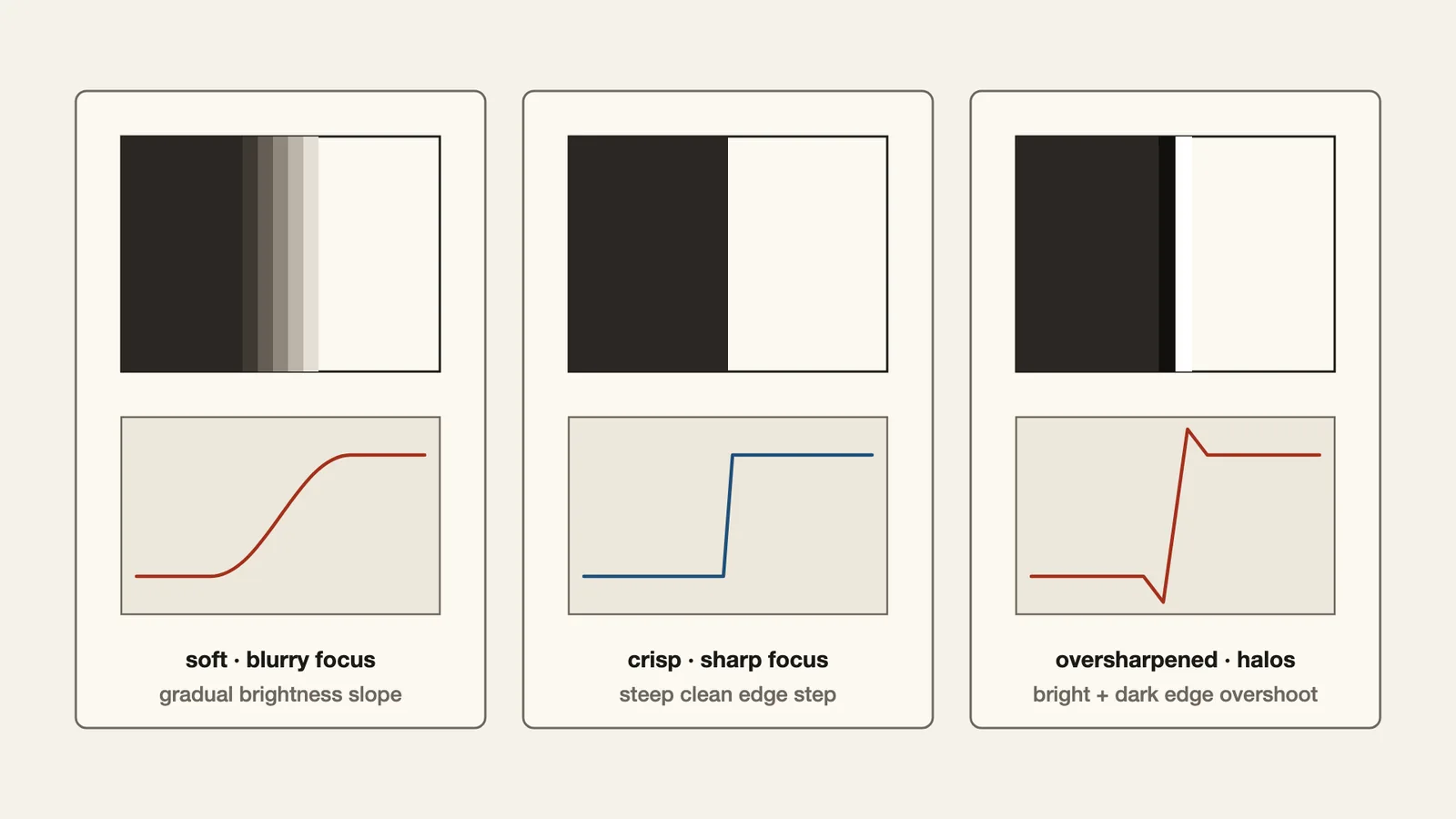
Sharpness is how crisp and clear the details and edges of an image appear. It combines resolution, the finest detail recorded, with acutance, the contrast at edges, so a lower-resolution picture with crisp edges can look sharper than a detailed but soft one. Focus, motion, lens quality and processing all affect it.
0 of 10 free entries left without an account. Create a free account to read without limits.
Meanings
- MusicThe quality of a note being slightly higher in pitch than intended.
How Sharpness works in practice
Most unsharp pictures fail at capture. Check focus first: put the autofocus point on the subject's eye or main edge and magnify the preview. Then check motion: a handheld shutter speed of at least 1/focal length (1/100 s at 100 mm on full frame) is a starting guide, faster with high-resolution sensors and moving subjects, slower if stabilisation works. Lenses are usually sharpest one to three stops down from wide open, around f/5.6 to f/8; past about f/16, diffraction softens fine detail. On a tripod, use a timer or remote and turn stabilisation off if the maker advises. In editing, capture sharpening restores edge contrast lost to the sensor's low-pass filter, and output sharpening is set for screen or paper. Overdoing it creates bright halos along edges.
Word origin
From Middle English sharpnesse, from Old English sċearpnes, formed from sċearp 'sharp' + -nes '-ness'. Sharp goes back to Proto-Germanic *skarpaz and ultimately to a Proto-Indo-European root meaning 'to cut', so the photographic sense extends the idea of a keen cutting edge to a clean visual edge.
In a sentence
The portrait looked sharp on the phone, but at 100 per cent the eyelashes showed motion blur.
Questions people ask
Is sharpness the same as resolution?
No. Resolution is the finest detail an image system can separate. Sharpness is the overall impression of crispness, which also depends on acutance, the steepness of contrast at edges. Sharpening software raises edge contrast and so increases apparent sharpness, but it cannot add detail that was never recorded. That is why a well-focused 12-megapixel image can look sharper than a blurred 45-megapixel one.
Why are my photos not sharp?
The usual causes, in order, are missed focus, camera shake or subject movement from too slow a shutter speed, and too shallow depth of field. Less often the cause is a dirty or poor lens, diffraction at very small apertures, heavy noise reduction, or a filter of low optical quality. Magnify the image: if nothing is sharp, suspect shake; if something behind the subject is sharp, focus missed.
Sources we checked
Cite this entry
RAP Education Photography School. "Sharpness." RAP Dictionary of Photography, Cinema & Visual Arts. https://dictionary.rapeducation.com/term/sharpness (accessed 28 November 2026).